OpenCode
Open-source terminal AI coding agent that works with 75+ model providers, plus an optional Zen gateway and Go subscription
OpenCode is an MIT-licensed terminal coding agent from Anomaly (the company formerly called SST), with more than 187,000 GitHub stars. The CLI itself is free and runs against 75+ providers with your own API key. Paid extras are optional: Go is $10/month and Go Plus $40/month for 31 curated models, and Zen is pay-as-you-go from $0.05 per 1M input tokens. Claude and Claude Code remain the stronger pick for coding quality and supported workflows; OpenCode wins on openness, cost control, and self-hosting.
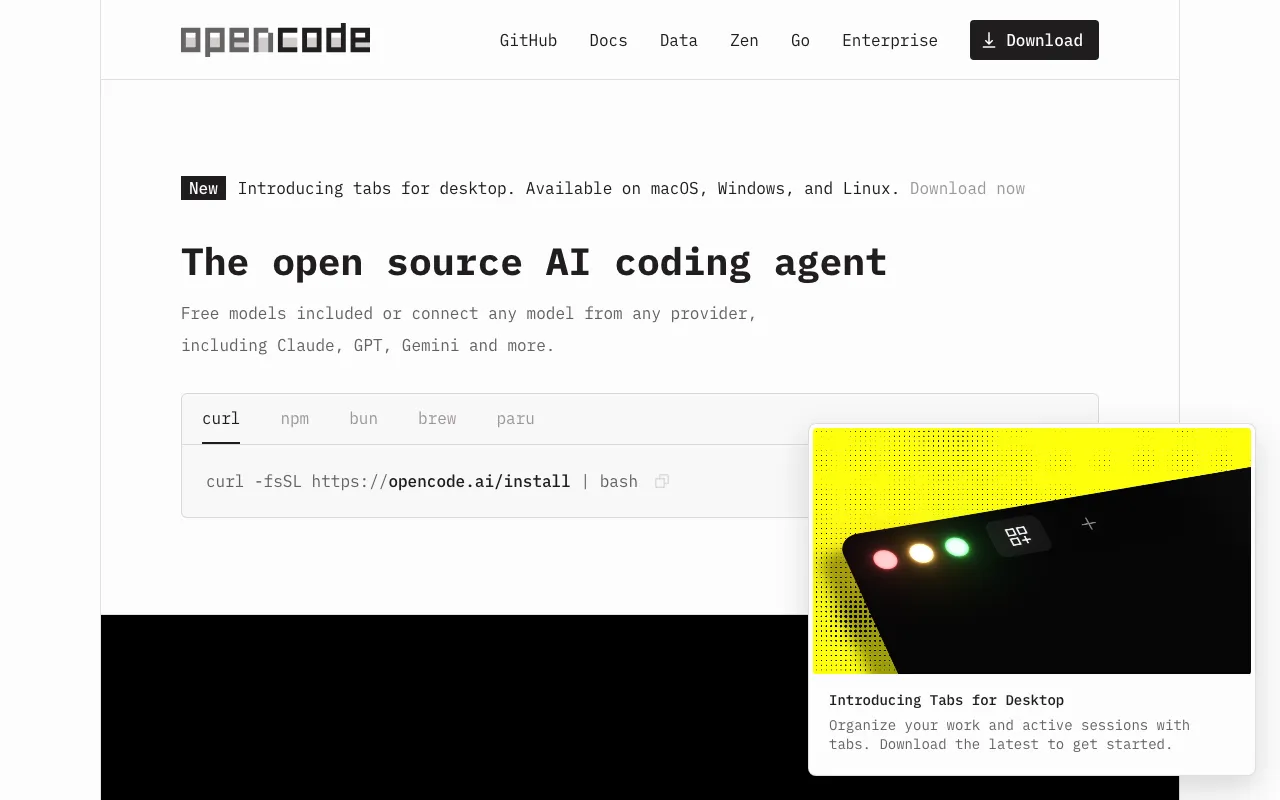
What is OpenCode?
OpenCode is an open-source AI coding agent that runs in your terminal, with a beta desktop app, an IDE extension, and a web interface alongside it. It is MIT-licensed and maintained by Anomaly, the company previously known as SST, which also builds OpenNext, OpenAuth, and OpenTUI. The agent ships with two modes you toggle using the Tab key: a build agent with full file and shell access, and a read-only plan agent that refuses edits and asks before running shell commands, which makes it safe to point at a codebase you do not yet trust yourself to modify. It loads the correct language servers automatically, so the model sees real diagnostics and symbol information rather than guessing from raw text.
The money model has two separate halves that are easy to conflate. The agent itself costs nothing: you install it and connect your own API key across 75+ providers via Models.dev, including local models, or sign in with a GitHub Copilot or ChatGPT Plus/Pro subscription you already pay for. Separately, the team sells model access. Zen is a pay-as-you-go gateway over 50+ curated coding models billed per 1M tokens, spanning free promotional models up to $30 input and $180 output for the most expensive option. Go is a flat subscription at $10/month, and Go Plus at $40/month, covering 31 curated models under per-model monthly limits set in dollars (for the most generous Go models, $12 per 5 hours, $30 weekly and $60 monthly). Neither is required. For teams, an Enterprise tier adds per-seat pricing, SSO, and a central config that can lock the agent to an internal gateway, but the rate is contact-only.
Who is it for?
OpenCode suits developers who already live in a terminal and want an agent they can inspect, fork, and point at whichever model they choose. The appeal is control rather than polish: there is no seat fee, no forced model, and no code stored by the vendor. If you want the most capable coding agent with the smoothest supported path, Claude and Claude Code are the stronger choice, and Cursor is a better fit if you want a full graphical editor. OpenCode earns its place when licence terms, provider choice, or per-token cost matter more than a managed experience.
- Terminal-native developers who prefer a TUI over a graphical editor and want agent sessions running next to their existing shell tooling.
- Cost-sensitive solo developers and small teams who want to route routine work to cheap open models through Go at $10/month and reserve frontier models for genuinely hard problems.
- Privacy-sensitive and regulated organizations that need the agent to talk only to an internal AI gateway, enforced through central config and SSO.
- Open-source contributors and tinkerers who want to read the implementation, write plugins against the SDK, or fork the agent under a permissive MIT licence.
- Developers with an existing Copilot or ChatGPT subscription who want to reuse that entitlement in a terminal agent instead of paying a second vendor.
How much does OpenCode cost?
Starting price: $0 · Free tier: yes · Model: open-source
Price history tracked from June 2026
| Plan | Price | Includes |
|---|---|---|
| OpenCode CLI | $0 | MIT licence, full source on GitHub · Bring your own API key across 75+ providers · Log in with an existing GitHub Copilot or ChatGPT Plus/Pro account · Terminal UI, desktop app (beta), IDE extension, web interface · No code or context data stored by the vendor |
| Go | $10/mo | 31 curated models, mostly open (GLM-5.3, Kimi K3, Qwen3.8 Max, DeepSeek V4.1) · Per-model monthly usage limits in dollars, mostly $15 to $80 · 5-hour window = 20% and weekly = 50% of each model's monthly limit · Single-member workspaces only; a Go workspace cannot invite members · Can fall back to your pay-as-you-go balance once limits are hit |
| Go Plus | $40/mo | Same models and token prices as Go · Higher per-model monthly limits, mostly $60 to $240 · Fewer interruptions, built for larger projects · Single-member workspaces only |
| Zen | Usage-based | Pay-as-you-go per 1M tokens across 50+ curated coding models · Five promotional models listed at no cost for a limited time · Claude Sonnet 5 at $2.00 input / $10.00 output per 1M tokens · Claude Opus 4.8 at $5.00 input / $25.00 output per 1M tokens · Auto-reloads $20 when balance drops below $5; can be disabled · Card processing fees passed through at cost (4.4% + $0.30) |
| Enterprise | Custom | Per-seat pricing, contact required — no public rate · Central config enforced across the organization · SSO integration for gateway credentials · Can restrict the agent to an internal AI gateway only · No token charges if you bring your own LLM gateway |
What are OpenCode's key features?
- Two built-in agents — build (full access) and plan (read-only) — switchable with the Tab key
- Automatic LSP loading so the model receives real language-server diagnostics and symbols
- Multi-session support for running several agents in parallel on one project
- 75+ LLM providers through Models.dev, including locally hosted models
- Share links that publish a session transcript for review or debugging, disableable via config
- Zen gateway offering 50+ curated coding models with per-1M-token billing
- Desktop app in beta for macOS, Windows, and Linux, with tabs for parallel sessions
- Central config with SSO and internal-gateway enforcement for enterprise deployments
What people use OpenCode for
- 01 Running an agent directly in the terminal against an existing repo without switching editors
- 02 Exploring an unfamiliar codebase with the read-only plan agent before permitting any file edits
- 03 Running several agent sessions in parallel on the same project to progress multiple tasks at once
- 04 Keeping source code inside a controlled network by pointing the agent at an internal AI gateway
- 05 Cutting model spend by routing routine work to open models via Go while reserving frontier models for hard problems
Pros and cons
| Pros | Cons |
|---|---|
| MIT-licensed with no vendor lock-in — you can audit, fork, or self-host, and you own all code it produces | Terminal-first by design: the desktop app is still beta and the IDE extension is thinner than a full editor, so most real work happens in a TUI |
| Works with 75+ providers including local models, and accepts existing GitHub Copilot or ChatGPT Plus/Pro logins | Bring-your-own-key billing makes cost unpredictable — a long session on Claude Opus 4.8 at $5.00 input and $25.00 output per 1M tokens escalates fast with no built-in per-session cap |
| Does not store code or context data; processing is local or direct to your chosen provider | Enterprise pricing is contact-only with no published per-seat rate, which makes budgeting harder than with competitors that list team prices |
| Go subscription at $10/month gives predictable spend on open models instead of an open-ended token bill | Young, fast-moving project created in April 2025 with over 4,700 open issues and pull requests, so churn and breaking changes between versions are common |
| Very actively maintained — more than 187,000 GitHub stars and commits landing daily | The OpenCode name is contested — an earlier Go-based project of the same name became Crush, and unrelated projects reuse the word, making support threads and docs easy to confuse |
What are the best OpenCode alternatives?
Aider is the closest OpenCode alternative in our directory: it covers the same category (AI Coding), starts at $0, has a free tier.
Ranked by category overlap with OpenCode, then free-tier availability, then lowest verified starting price — computed from our verified data, never from sponsorships.
| Alternative | What it is | Starting price | Free tier | Price verified |
|---|---|---|---|---|
| Aider vs OpenCode → | Open-source AI pair programming in your terminal — bring your own LLM key and edit your git repo | $0 | yes | Jun 22, 2026 |
| Amp | Sourcegraph's agentic coding tool — autonomous agents across CLI, editors, and web with zero-markup usage billing | $0 | yes | Jun 28, 2026 |
| Cline | Open-source autonomous coding agent for VS Code that edits files, runs commands, and brings your own model | $0 | yes | Oct 23, 2026 |
| OpenHands vs OpenCode → | Open-source autonomous AI software-engineering agent that writes code, runs commands, and fixes issues | $0 | yes | Jun 24, 2026 |
| OpenAI Codex | OpenAI's software-engineering agent — open-source CLI, IDE extension, and cloud tasks, bundled with every ChatGPT plan | $8/mo | yes | Jul 6, 2026 |
| Claude | Anthropic's AI assistant built for long-context analysis, coding, and safe reasoning | $20/mo | yes | Jul 3, 2026 |
| Cursor | AI-native code editor that runs autonomous agents to build, test, and review code | $20/mo | yes | Jul 3, 2026 |
Head-to-head comparisons
How people make money with OpenCode
- Freelance and contract development billed hourly or per project, using parallel agent sessions to raise throughput without adding headcount
- Consulting on privacy-safe AI coding rollouts for regulated teams — central config, SSO, and internal gateway setup billed as a fixed-scope engagement
Frequently asked questions
Is OpenCode free?
Yes. The OpenCode CLI is MIT-licensed and free to download and run. You supply your own API key from any of 75+ supported providers, or log in with an existing GitHub Copilot or ChatGPT Plus/Pro account. The optional paid add-ons, Go and Zen, are separate purchases you never have to make.
What is OpenCode Zen?
Zen is an optional AI gateway operated by the OpenCode team. It offers a curated, benchmarked set of coding models billed pay-as-you-go per 1M tokens, ranging from free promotional models up to $30 input and $180 output for GPT 5.5 Pro. Balances auto-reload $20 when they fall below $5, and card processing fees are passed through at cost.
How much does OpenCode Go cost?
Go is $10 per month and Go Plus is $40 per month, with the same 31 curated models and token prices. Each model has a monthly usage limit in dollars, mostly $15 to $80 on Go and $60 to $240 on Go Plus, with 5-hour and weekly windows at 20% and 50% of it. Both are for single-member workspaces.
Is OpenCode the same project as Crush?
No. The original terminal agent by Kujtim Hoxha moved to the Charm organization during a 2025 naming dispute and was renamed Crush. The team that owned the official domain kept the OpenCode name and rewrote the agent in TypeScript. Reports of that split come from third-party coverage, so treat the finer details as approximate.
Who maintains OpenCode?
OpenCode is built by Anomaly, the company previously known as SST, which also maintains OpenNext, OpenAuth, and OpenTUI. The GitHub repository moved from the sst organization to anomalyco after the rebrand, and the old path still redirects. The project is MIT-licensed, with roughly 900 contributors and more than 187,000 GitHub stars.
Does OpenCode work outside the terminal?
Yes, though the terminal remains the primary interface. There is a desktop app in beta for macOS, Windows, and Linux, plus an IDE extension and a web interface. The desktop build recently added tabs for organizing parallel sessions. Because that app is still labelled beta, the terminal UI is the more stable choice for daily work.
Does OpenCode have an enterprise plan?
Yes. OpenCode Enterprise uses per-seat pricing and requires contacting the team, as no public price is listed. It adds a central config that integrates with your SSO provider and can restrict the agent to your internal AI gateway. If you bring your own gateway, OpenCode does not bill for tokens. The vendor recommends an internal trial first.