Airtable
No-code app-building platform with relational databases, automations, and AI agents
Airtable is a no-code platform that combines relational databases, workflow automations, and AI agents into custom business apps. The free tier supports 1,000 records per base, up to 5 editors, 100 automation runs/month, and 250 AI credits/editor/month. Paid plans start at $20/user/month (annual). Best for operations and product teams that need structured data with automation and a UI — without writing code.
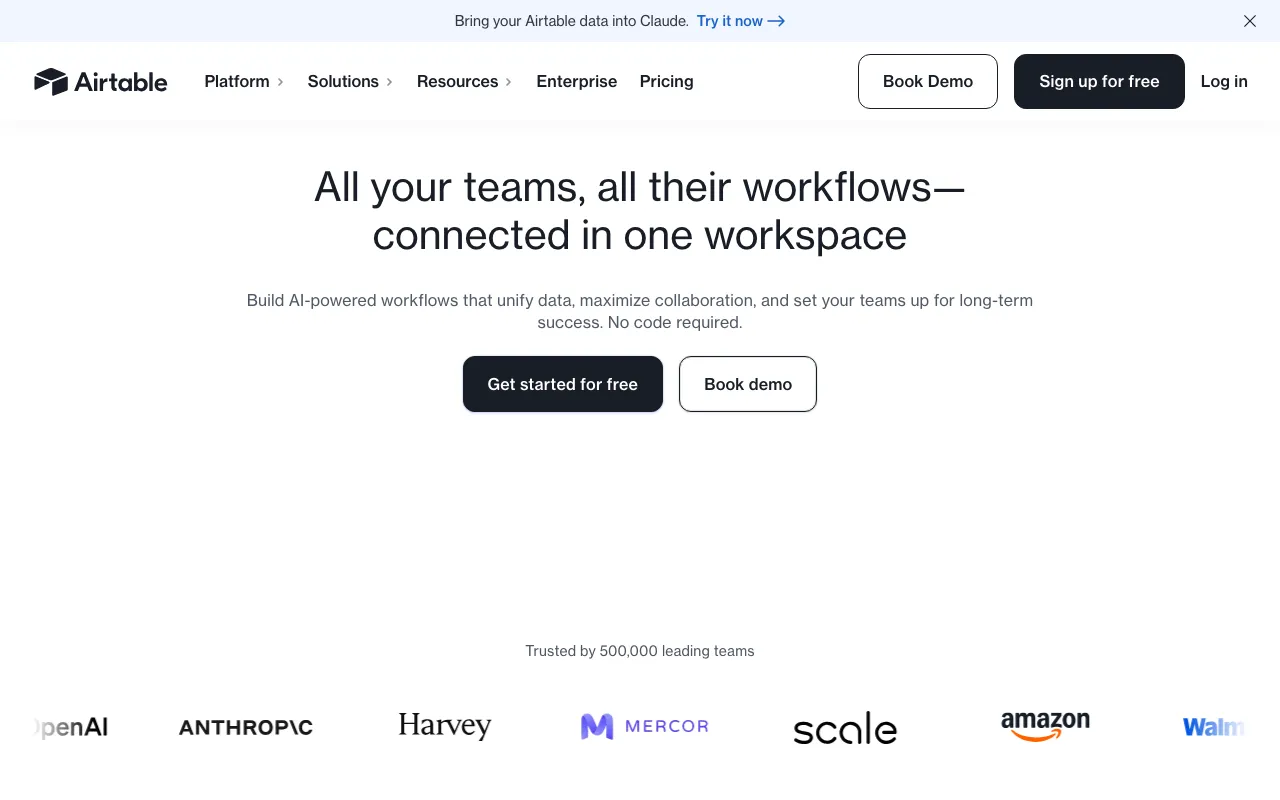
What is Airtable?
Airtable is a no-code platform that sits between a spreadsheet and a relational database. Each base can hold multiple tables with typed fields (text, number, attachment, linked record, formula, and more), and those tables can reference each other the way foreign keys work in SQL — without requiring any SQL. On top of the data layer, Airtable adds a drag-and-drop Interface Designer for building dashboards and portals, a native automation engine for event-driven workflows, and an AI layer that can classify, summarize, or enrich records using models from OpenAI, Anthropic, Google, and Meta.
The platform’s AI agent capability is its most recent and differentiated feature. Rather than one-off field transformations, AI agents in Airtable can be given a goal, then autonomously read, update, and act across thousands of records — routing support tickets, enriching leads, or generating draft content in bulk. Airtable supports data residency for Enterprise customers and explicitly states that no customer data is used to train its underlying models.
Who is it for?
Airtable targets non-engineering teams that manage structured, recurring work — operations managers building asset trackers, marketing teams coordinating campaign pipelines, product managers running roadmaps, and HR teams processing applicant workflows. It is also used by technical users who want a fast internal tool or client-facing portal without writing a backend.
Specific user types:
- Operations and project managers who need a database they can actually edit and share without IT involvement, and who want automations to replace repetitive data-entry steps.
- Marketing and content teams running multi-stage workflows (brief → draft → review → publish) where each record moves through statuses and triggers notifications automatically.
- Product teams using Airtable as a lightweight product data system — feature requests, bug tracking, or roadmap views — connected to GitHub or Jira via sync integrations.
- Agencies and consultants building client-facing portals or intake forms on top of Airtable bases, taking advantage of free viewer seats to avoid billing clients.
How much does Airtable cost?
Starting price: $20/user/mo · Free tier: yes · Model: freemium
Price history tracked from June 2026
| Plan | Price | Includes |
|---|---|---|
| Free | Free | 1,000 records per base · Up to 5 editors · 1 GB attachment storage per base · 100 automation runs/month · 250 AI credits/editor/month |
| Team | $20/user/mo | 50,000 records per base · Unlimited editors · 25,000 automation runs/month · Interface Designer · Billed annually |
| Business | $45/user/mo | 125,000 records per base · Advanced admin controls · 125,000 automation runs/month · Two-way sync integrations · Billed annually |
| Enterprise Scale | Custom | 500,000 records per base · Unlimited workspaces and bases · SAML SSO and audit logs · Data residency options |
What are Airtable's key features?
- Relational databases with multiple view types (grid, gallery, Kanban, Gantt, calendar)
- No-code Interface Designer for building custom dashboards and portals
- AI agents that can operate autonomously across thousands of records
- Native AI fields using OpenAI, Gemini, Llama, and Anthropic models
- Automations triggered by record changes, schedules, or external webhooks
- REST API and integrations with Slack, Salesforce, GitHub, and 1,000+ apps via Zapier/Make
- Granular role-based access control; read-only viewers do not count toward seat cost
- Data residency options and no customer data used for model training (Enterprise)
What people use Airtable for
- 01 Building a product roadmap database with custom interfaces for different stakeholders
- 02 Automating marketing campaign workflows that span content creation, approval, and publishing
- 03 Running AI agents to classify, enrich, or summarize thousands of records automatically
- 04 Replacing spreadsheets with a relational database that non-engineers can edit
- 05 Managing vendor or contractor pipelines with form intake and automated follow-ups
Pros and cons
| Pros | Cons |
|---|---|
| Free viewers and form submitters are not billed — practical for client-facing portals | Per-seat pricing becomes expensive fast for larger teams; $20/user/mo billed annually only |
| AI fields are available on the free tier (250 credits/editor/month) for evaluation | Free tier 1,000 records per base is too low for most real workflows beyond prototyping |
| Multiple AI model providers supported in the same workspace | Advanced automations and enterprise governance locked behind Business or Enterprise tiers |
| Exceeding record limits never deletes data — read access persists until upgrade | No offline mode; fully browser-dependent |
What are the best Airtable alternatives?
CrewAI is the closest Airtable alternative in our directory: it covers the same category (AI Agents & Automation), starts at $0, has a free tier.
Ranked by category overlap with Airtable, then free-tier availability, then lowest verified starting price — computed from our verified data, never from sponsorships.
| Alternative | What it is | Starting price | Free tier | Price verified |
|---|---|---|---|---|
| CrewAI | Open-source multi-agent framework for orchestrating collaborative AI agent teams | $0 | yes | Jul 3, 2026 |
| Make vs Airtable → | Visual automation platform connecting 3,000+ apps with no-code workflows and AI agents | $9/mo | yes | Jul 3, 2026 |
| Relevance AI | No-code platform for building and deploying autonomous AI agents for business workflows | $19/mo | yes | Jun 11, 2026 |
| Zapier vs Airtable → | No-code automation platform that connects 7,000+ apps to build multi-step workflows without writing code | $19.99/mo | yes | Jun 11, 2026 |
| n8n vs Airtable → | Open-source workflow automation platform for building AI agents and multi-app integrations | €20/mo | yes | Jul 3, 2026 |
| Notion | AI workspace combining docs, databases, projects, and autonomous agents in one platform | $10/member/mo | yes | Aug 27, 2026 |
How people make money with Airtable
- Build and sell Airtable base templates on Gumroad or the Airtable Marketplace — productized templates for CRMs, project trackers, and content calendars
- Offer Airtable consulting and implementation on Upwork or Toptal — specialized workflow builds and migrations for client teams
Frequently asked questions
Is Airtable free?
Yes. The Free plan supports unlimited bases, up to 5 editors, 1,000 records per base, 100 automation runs/month, and 250 AI credits per editor/month. It has no time limit.
How much does Airtable cost?
Paid plans start at $20/user/month (Team, billed annually) and $45/user/month (Business, billed annually). Enterprise Scale is custom-priced. Monthly billing is available at roughly 20% higher rates.
What is the record limit on Airtable's free plan?
The Free plan allows 1,000 records per base. The Team plan raises this to 50,000, Business to 125,000, and Enterprise Scale to 500,000.
Does Airtable have AI features?
Yes. Airtable includes AI fields powered by OpenAI, Gemini, Llama, and Anthropic models. Free users get 250 AI credits per editor per month. It also supports autonomous AI agents that can process and act on records at scale.
What is the difference between Airtable and Notion?
Airtable is primarily a structured relational database and app-building platform focused on data operations and automation. Notion combines a document editor with databases and is more suited to knowledge management and wikis.
Does Airtable charge for read-only users?
No. Viewers, form submitters, and users accessing share links are free on all plans. Only editors (users who can modify data) count toward the per-seat cost.
Can Airtable replace Zapier or Make?
Partially. Airtable's native automations handle common triggers and actions, but Zapier and Make support more app connectors and complex multi-step logic. Many teams use Airtable as the data layer alongside a dedicated automation tool.