Guru
AI knowledge platform combining an internal wiki, enterprise search, and intranet with answers delivered in Slack, Teams, and the browser
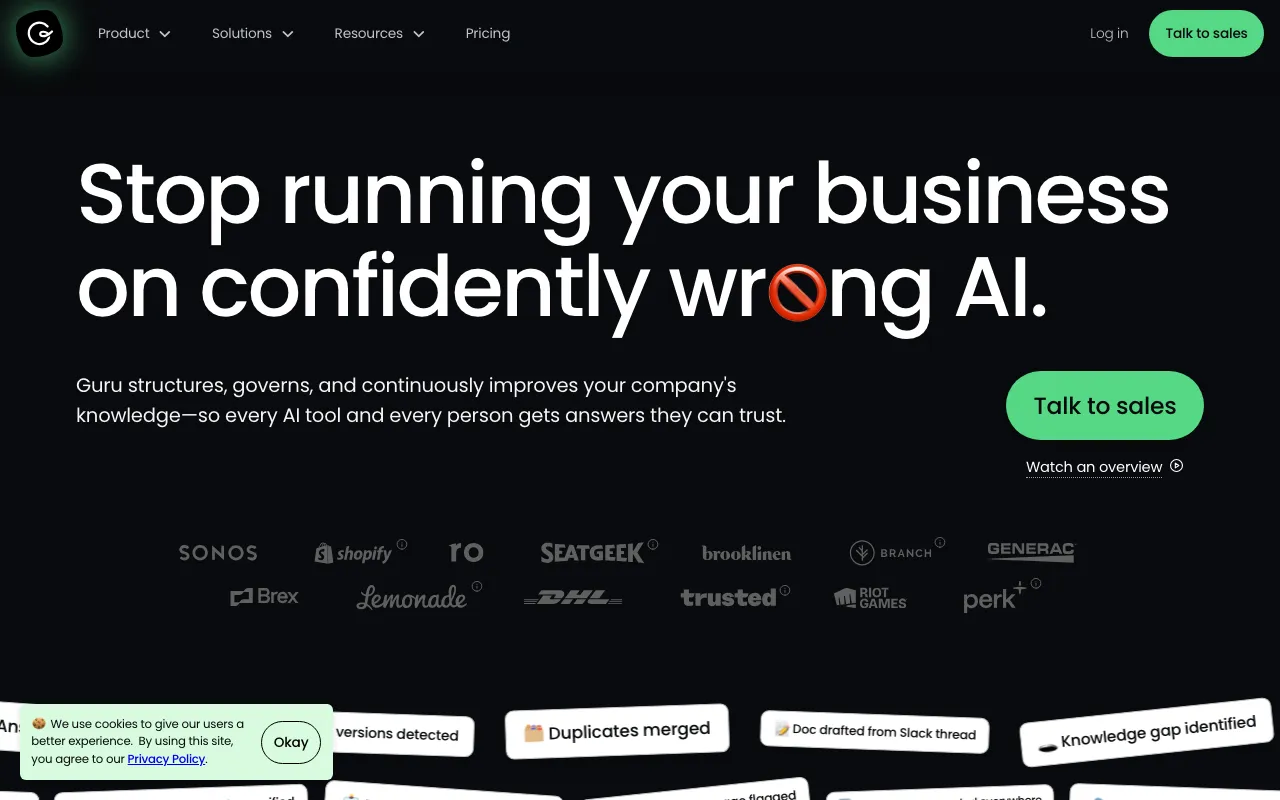
Guru is an AI knowledge platform that indexes 100+ enterprise sources into one permission-aware layer and answers questions inside Slack, Teams, the browser extension, or any MCP client. Guru removed published prices from its pricing page between March and April 2026; it is now contact-sales only. The last first-party figure was $25 per seat per month billed annually ($30 monthly), with a 10-seat minimum and AI credits included in the seat.
What is Guru?
Guru is an AI knowledge platform that merges three things companies usually buy separately: an internal wiki, enterprise search, and an intranet. It connects to 100+ enterprise sources — Slack, Microsoft Teams, Salesforce, Zendesk, Confluence, SharePoint, Google Drive, file systems — and builds a single retrieval index where each document keeps the access controls it had in its original system. Employees then ask questions wherever they already work: a Slack or Teams message, a Chrome or Edge extension overlaid on whatever app is open, or the Guru web app. Every AI answer carries enforced citations and an audit trail back to the source.
What separates Guru from a pure search layer is that it tries to improve the knowledge rather than just find it. Knowledge Agents verify and unverify content on schedules driven by usage signals, content age, and policy rules — Guru says this handles roughly 80–90% of verification automatically, escalating to human experts only when needed. The platform also detects gaps, drafts documentation from meetings and support tickets for subject-matter-expert approval, deduplicates conflicting content, and auto-archives stale material. A correction made once propagates everywhere, including out through Guru’s MCP server to external AI clients. Commercially, Guru changed shape in early 2026: through March its pricing page advertised a self-serve plan at $25 per seat per month billed annually ($30 monthly) with a ten-seat minimum and AI credits bundled into the seat. By mid-April both the prices and the free signup link were gone, replaced by a contact-sales “platform plus expertise” package that bundles solution engineers, knowledge-architecture design, and agent tuning alongside the software.
Who is it for?
Guru now targets mid-market and enterprise organizations that have knowledge scattered across many SaaS tools and need it governed, verified, and pushed into the places employees actually work. With the self-serve plan withdrawn there is no free tier, no public trial, and no way to sign up without talking to sales, so it is no longer a realistic option for small teams or individual evaluation. Its strongest fit is an organization that already tried a wiki, watched it rot, and wants maintenance automated rather than assigned to someone as a side duty.
- Customer support and success teams that need verified, cited answers surfaced inside Zendesk or Salesforce while an agent is on a live ticket.
- HR, IT, and operations teams looking to deflect repetitive internal questions by making existing policy and process documentation findable and provably current.
- Regulated organizations in healthcare, finance, and pharma that require permission inheritance, answer lineage, centralized audit logs, and SOC 2 Type II, HIPAA, or GxP alignment.
- Platform teams standardizing enterprise AI that want one governed knowledge layer feeding tools like Claude, Microsoft Copilot, and ChatGPT over MCP instead of rebuilding permissions per tool.
- Companies comparing enterprise AI search vendors who are already evaluating Glean and want a knowledge-maintenance angle rather than pure retrieval.
How much does Guru cost?
Starting price: Custom · Free tier: no · Model: contact
Price history tracked from June 2026
| Plan | Price | Includes |
|---|---|---|
| Platform + Expertise package | Custom | Contact sales — Guru publishes no price on its pricing page as of July 2026 · Scoped to organization size, knowledge complexity, and AI maturity · Includes the AI knowledge layer, Knowledge Agents, and AI search · Bundled solution-engineering: knowledge architecture, agent tuning, rollout support · 100+ integrations and MCP delivery to external AI tools · SOC 2 Type II, HIPAA, GxP, SSO, SCIM, DLP masking, audit logs |
| Self-serve (withdrawn April 2026) | $25/seat/mo | Last first-party price published on the Guru pricing page, live through March 2026 · $30 per seat per month on monthly billing · 10-seat minimum, so the practical floor was a ten-seat commitment · AI credits included in the seat, with usage limits — not a separate add-on · No longer offered; the self-serve signup link was removed from the site |
What are Guru's key features?
- 100+ source connectors feeding a single unified retrieval index rather than per-app silos
- Permission-aware ingestion — every source keeps its original access controls, so people and agents see only what they are entitled to
- Knowledge Agents that verify, unverify, and update content rather than only retrieving it
- Automated verification and maintenance covering roughly 80–90% of review cycles via usage signals, content age, and policy rules
- Chrome and Edge browser extensions that surface answers over whatever app is on screen
- Slack and Microsoft Teams apps for in-workflow question answering
- MCP server that exposes the governed knowledge layer to third-party AI clients
- Citation enforcement and answer lineage — every AI answer carries its sources and an audit trail
- Gap detection that flags missing documentation and drafts structured content where none exists
- REST API and no-code connectors via Zapier, Workato, and Prismatic
What people use Guru for
- 01 Answering employee questions inside Slack or Microsoft Teams without leaving the conversation
- 02 Running an internal wiki whose articles are auto-verified on a schedule instead of silently going stale
- 03 Enterprise search across Salesforce, Zendesk, Confluence, SharePoint, Google Drive, and file systems from one index
- 04 Deflecting repetitive IT, HR, and customer-support tickets by surfacing an existing verified answer
- 05 Serving governed company knowledge to Claude, Copilot, Cursor, and ChatGPT through Guru's MCP server
- 06 Auto-drafting documentation from meetings, tickets, and chat threads, then routing it to a subject-matter expert for approval
Pros and cons
| Pros | Cons |
|---|---|
| Knowledge maintenance is the core product, not an afterthought — scheduled verification and auto-archival fight the stale-wiki problem directly | No published pricing since April 2026 — every deal is quoted by sales, so budgeting and vendor comparison rely on unofficial estimates |
| When Guru last published prices, AI credits were included in the base seat rather than sold as a separate per-user add-on | The self-serve plan and free signup were removed; there is no free tier and no public trial, only a sales conversation |
| MCP server means Guru feeds existing AI tools instead of forcing employees into another chat window | The last published plan carried a 10-seat minimum, so very small teams were already priced out before the shift to enterprise-only |
| Permission inheritance and citation enforcement are platform-level, which suits regulated buyers needing SOC 2 Type II, HIPAA, and GxP | AI usage runs on a credit pool with usage limits, which makes heavy agent and research workloads harder to forecast than a flat seat fee |
| Answers reach people where they already work — Slack, Teams, and a browser extension — instead of a separate destination site | Value depends on connecting a broad set of company apps, so a rollout is a multi-week knowledge-architecture project rather than an install |
What are the best Guru alternatives?
Glean is the closest Guru alternative in our directory: it covers the same category (AI Search & Research), starts at Custom, has no free tier.
Ranked by category overlap with Guru, then free-tier availability, then lowest verified starting price — computed from our verified data, never from sponsorships.
| Alternative | What it is | Starting price | Free tier | Price verified |
|---|---|---|---|---|
| Glean | Enterprise Work AI platform unifying AI search, an assistant, and agents over a permission-aware company knowledge graph | Custom | no | Jul 12, 2026 |
| Coda | All-in-one workspace blending docs, spreadsheet-style tables, and no-code apps, with Coda AI built in for chat, generation, and AI columns | $0 | yes | Jul 14, 2026 |
| Microsoft Copilot | Microsoft's GPT-5-powered AI assistant for chat, search, and AI inside Word, Excel, and Teams | $0 | yes | Jun 22, 2026 |
| NotebookLM | Google's AI research assistant that answers questions grounded in your own uploaded sources | $7.99/mo | yes | Jun 11, 2026 |
| Notion | AI workspace combining docs, databases, projects, and autonomous agents in one platform | $10/member/mo | yes | Aug 27, 2026 |
| Perplexity | AI-powered answer engine that searches the live web and cites every source | $20/mo | yes | Jun 11, 2026 |
Frequently asked questions
How much does Guru cost?
Guru no longer publishes a price. Its pricing page asks buyers to book a call and scopes a package to organization size and knowledge complexity. The last first-party figure, live through March 2026, was $25 per seat per month billed annually or $30 billed monthly, with a ten-seat minimum. Treat that as historical, not a current quote.
Does Guru have a free plan or free trial?
Not anymore. Guru previously offered a self-serve signup with a free trial, but by April 2026 the pricing page dropped both the prices and the signup link. The only calls to action now are contacting sales and watching an overview video, so evaluation happens through a scoped conversation rather than a public free plan.
Is Guru's AI a paid add-on?
No. When Guru last published pricing, AI credits were included in the base seat with usage limits applied, not billed as a separate per-user add-on. That differs from vendors that charge an extra monthly fee per user for AI features. Heavy usage still draws down a credit pool, so overages are the cost variable rather than an upfront surcharge.
How many integrations does Guru have?
Guru advertises 100+ source connectors, covering Slack, Microsoft Teams, Salesforce, Zendesk, Confluence, SharePoint, Google Drive, and file systems. It also connects through Zapier, Workato, and Prismatic for no-code automation, and exposes a REST API for custom work.
How is Guru different from Glean?
Glean indexes and retrieves what already exists across company apps. Guru positions itself as structuring and continuously improving knowledge — verification schedules, gap detection, auto-archival, and corrections that propagate everywhere. Guru also pushes its knowledge layer into external AI tools via MCP rather than competing with them. Both are now contact-sales enterprise products with no public price.
Does Guru work inside Slack and Microsoft Teams?
Yes. Guru ships apps for both Slack and Microsoft Teams so employees can ask a question and get a cited answer without switching tools. It also offers Chrome and Edge browser extensions that surface relevant knowledge over whatever web application is currently open.
Does Guru respect existing permissions?
Yes. Permissions are inherited at ingestion from each connected source and enforced across every Guru surface, so users and AI agents only see content they already have access to. Guru also provides centralized audit logs, answer lineage, SSO, SCIM provisioning, and DLP masking, and states that customer data does not train its AI models.
Is Guru still an independent company?
Yes. Guru Technologies is a Philadelphia-based company that has raised roughly $68 million across six rounds from investors including Accel, Thrive Capital, Emergence, and the Slack Fund. There is no record of an acquisition, and the product is actively shipping — Knowledge Agents and the MCP server are recent additions.