Jules
Google's asynchronous AI coding agent that clones your repo, plans changes, runs in a cloud VM, and opens a reviewable pull request
Jules is Google's asynchronous AI coding agent, powered by Gemini. It clones your GitHub repository into a cloud VM, generates a plan you approve, then writes code in the background and opens a pull request you can review. The free tier allows 15 tasks per day with 3 concurrent tasks; bundled in Google AI Pro at $19.99/month it rises to 100 tasks/day, and Google AI Ultra (from $100/month) reaches 300 tasks/day with priority model access. Best for offloading routine, parallelizable coding work.
What is Jules?
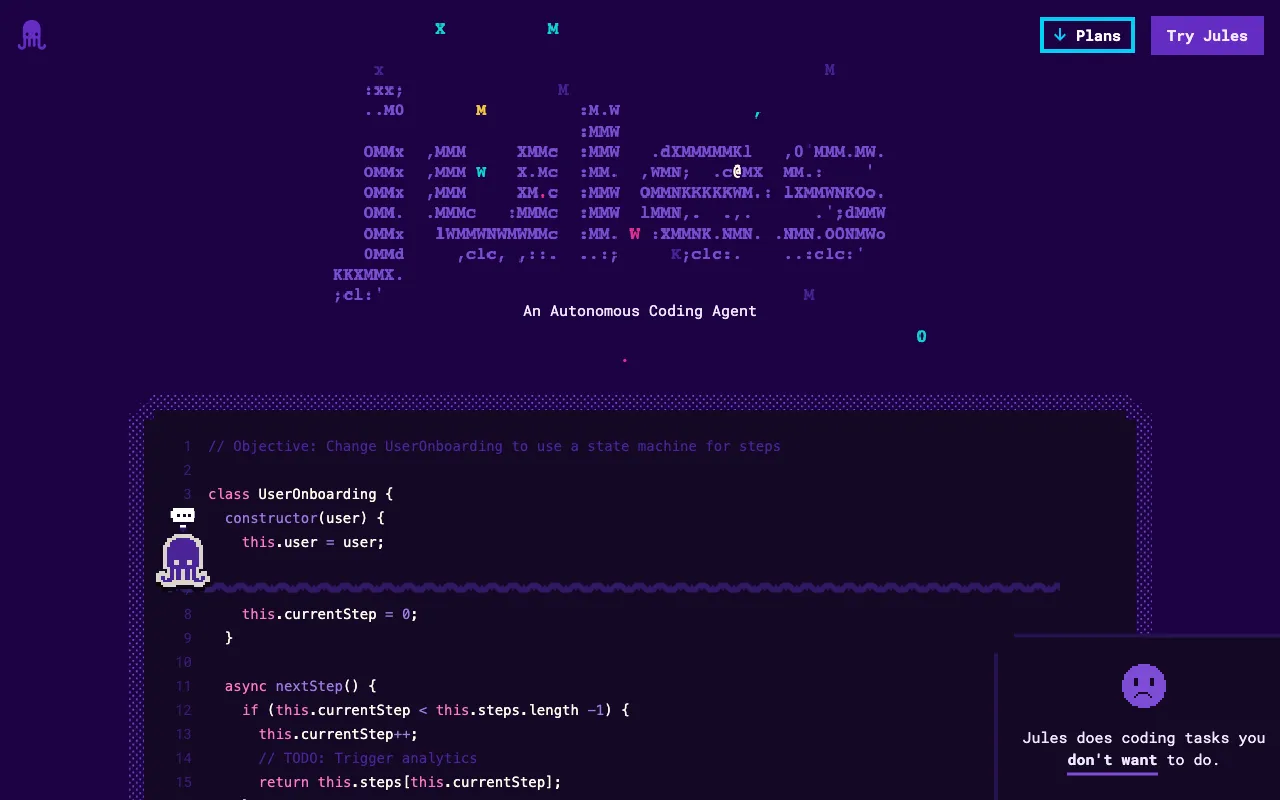
Jules is Google’s asynchronous AI coding agent. Rather than completing code as you type, it works like a teammate you hand a ticket to: you connect a GitHub repository and describe a task, Jules clones the repo into a dedicated cloud VM, generates a plan for your approval, and then carries out the work in the background. When it finishes, it opens a pull request with a diff you can review, comment on, and merge. It is powered by Google’s Gemini models — Gemini 2.5 Pro on the free tier and the latest Gemini on paid tiers — and it is designed for routine, parallelizable work such as bug fixes, dependency bumps, test writing, and small feature builds.
Jules became generally available in August 2025 and is now offered in three tiers. The free tier allows 15 tasks per day with up to 3 concurrent tasks. Paid access is bundled into Google’s broader AI subscriptions: Google AI Pro at $19.99/month raises the limits to 100 tasks per day and 15 concurrent tasks, while Google AI Ultra — repriced at Google I/O 2026 to start around $100/month, up to $200/month — reaches 300 tasks per day, 60 concurrent tasks, and priority access to the newest model. Because the plan-first workflow requires you to approve a plan and review the final diff, a human stays in the loop on every change.
Who is it for?
Jules suits developers who want to offload well-defined, repetitive coding work to an agent and review the results on their own schedule, rather than pairing with an AI in real time. Its daily task caps make it a fit for steady background work rather than high-volume, CI-style automation.
- Individual developers who want to clear small bugs and chores in parallel while focusing on harder problems.
- Daily and professional coders who can justify a Google AI Pro subscription and want 100 tasks/day of async help.
- Teams running multi-agent workflows that need higher concurrency and the larger Ultra task limits.
- Open-source maintainers handling a backlog of small, well-scoped issues across one or more repositories.
How much does Jules cost?
Starting price: $0 · Free tier: yes · Model: freemium
Price history tracked from June 2026
| Plan | Price | Includes |
|---|---|---|
| Jules (Free) | Free | 15 tasks per day · Up to 3 concurrent tasks · Powered by Gemini 2.5 Pro · GitHub integration and PR creation |
| Google AI Pro | $19.99/mo | 100 tasks per day (about 5x the free limits) · Up to 15 concurrent tasks · Higher access to the latest model (starting with Gemini 3 Pro) · Bundled in the Google AI Pro subscription |
| Google AI Ultra | From $100/mo | 300 tasks per day (about 20x the free limits) · Up to 60 concurrent tasks · Priority access to the latest model · Repriced at Google I/O 2026; top tier reaches $200/mo |
What are Jules's key features?
- Asynchronous execution in a dedicated cloud VM, so tasks run in the background
- GitHub integration with branch selection and automatic pull-request creation
- Plan-first workflow: Jules proposes a plan you approve before it writes code
- Diff-based change preview for reviewing every edit
- Concurrent task execution, up to 3 / 15 / 60 by tier
- Powered by Gemini 2.5 Pro on free, the latest Gemini on paid tiers
- Per-day task quotas scaled by plan (15 / 100 / 300)
- Common task automation: bug fixes, version bumps, test writing, feature building
What people use Jules for
- 01 Fixing a backlog of small, well-scoped bugs in parallel without babysitting each one
- 02 Bumping dependency versions and updating code to match across a repository
- 03 Writing missing unit tests for existing modules in the background
- 04 Building a small feature from a written description and reviewing the resulting pull request
- 05 Delegating routine refactors while you focus on architecture and review
Pros and cons
| Pros | Cons |
|---|---|
| Truly asynchronous — set a task, walk away, and review a pull request later | Hard daily task caps even on paid plans (300/day on Ultra) constrain heavy automated use |
| Generous free tier of 15 tasks per day with no separate purchase | Paid tiers require a Google AI Plans subscription tied to an individual Google account, with limited account-type support |
| Plan-first approval and diff review keep a human in the loop on every change | Asynchronous cloud-VM model means no real-time, interactive pairing — you wait and review rather than collaborate live |
| Paid access is bundled into existing Google AI Pro and Ultra subscriptions | No public API documented, so it cannot be wired into custom pipelines |
What are the best Jules alternatives?
OpenHands is the closest Jules alternative in our directory: it covers the same category (AI Coding), starts at $0, has a free tier.
Ranked by category overlap with Jules, then free-tier availability, then lowest verified starting price — computed from our verified data, never from sponsorships.
| Alternative | What it is | Starting price | Free tier | Price verified |
|---|---|---|---|---|
| OpenHands | Open-source autonomous AI software-engineering agent that writes code, runs commands, and fixes issues | $0 | yes | Jun 24, 2026 |
| Devin | Autonomous AI software engineer from Cognition that takes whole engineering tasks from ticket to pull request | $20/mo + $2.25/ACU | no | Jun 20, 2026 |
| GitHub Copilot | AI coding assistant with inline completions, chat, and autonomous agent mode across major IDEs | $10/mo | yes | Jul 3, 2026 |
| Claude | Anthropic's AI assistant built for long-context analysis, coding, and safe reasoning | $20/mo | yes | Jul 3, 2026 |
| Cursor | AI-native code editor that runs autonomous agents to build, test, and review code | $20/mo | yes | Jul 3, 2026 |
How people make money with Jules
- Open-source maintenance retainers — point Jules at a backlog of small issues (dependency bumps, test coverage, bug fixes), review its pull requests, and charge maintainer retainers per repository for keeping projects green
- Offer async feature delivery for small clients by queueing well-scoped tasks to Jules and reviewing the resulting diffs, billing per project rather than per hour
Frequently asked questions
Is Jules free?
Yes. Jules has a free tier that allows 15 tasks per day with up to 3 concurrent tasks, powered by Gemini 2.5 Pro. Higher limits require a Google AI Pro or Ultra subscription.
How much does Jules cost?
Jules itself has no standalone price — paid access is bundled into Google AI subscriptions. Google AI Pro is $19.99/month and raises Jules to 100 tasks/day with 15 concurrent tasks; Google AI Ultra starts at around $100/month and reaches 300 tasks/day with 60 concurrent tasks and priority model access.
How does Jules work?
You connect a GitHub repository and describe a task. Jules clones the repo into a cloud VM, generates a plan for your approval, then executes the work asynchronously in the background and opens a pull request with a reviewable diff.
Which model powers Jules?
Jules runs on Google's Gemini models — Gemini 2.5 Pro on the free tier, with higher and priority access to the latest model (starting with Gemini 3 Pro) on the paid Pro and Ultra tiers.
Is Jules better than Claude for coding?
Jules is an autonomous agent built on Google's Gemini models, optimized for hands-off, asynchronous tasks that end in a pull request. For direct, interactive code generation and reasoning, Claude remains the stronger choice; Jules is best when you want to queue work and review it later rather than pair in real time.
Does Jules have an API?
No. As of mid-2026 Jules has no public API documented on its official pages. It is driven through its web interface and GitHub integration rather than programmatically.