Portkey
AI gateway and observability control plane that routes, caches, and guardrails LLM calls across 1,600+ models
Portkey is an AI gateway and observability platform that routes, caches, and adds guardrails to LLM calls across 1,600+ models through one unified API. The open-source gateway is free and self-hostable; the hosted platform adds a free Developer tier, Production at $49/month for 100,000 logs, and custom Enterprise. Best for teams moving LLM and agent apps into production. Now part of Palo Alto Networks.
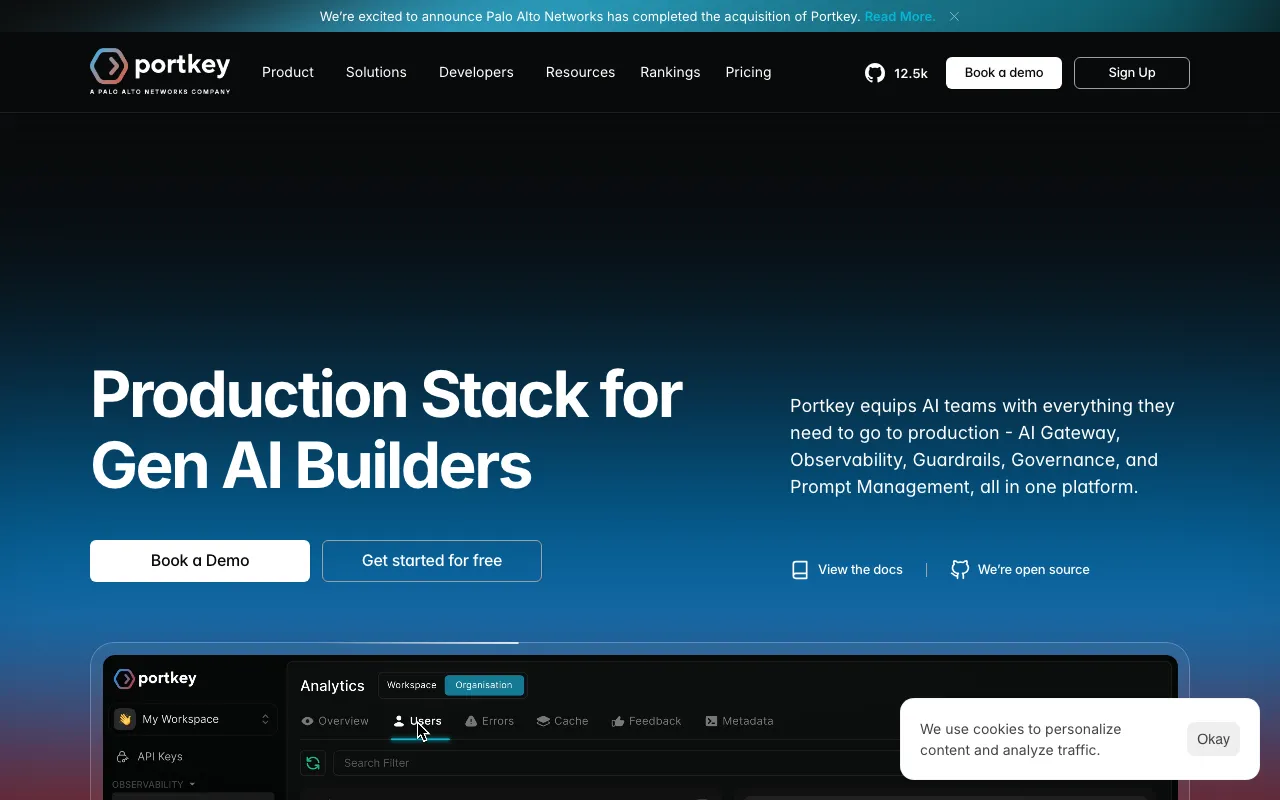
What is Portkey?
Portkey is an AI gateway and observability control plane for teams running LLM and agent applications in production. It sits between your application and model providers, exposing one OpenAI-compatible API that reaches more than 1,600 models. Through that single integration you get automatic fallbacks, retries, timeouts, load balancing, and caching, so a provider outage or rate limit degrades gracefully instead of breaking your app. On top of the gateway, Portkey layers real-time observability — logs, traces, cost, and latency analytics broken down by model, prompt, and user.
The platform also handles the operational surface around prompts and safety: versioned prompt management with a playground, configurable guardrails that check inputs and outputs for issues like PII or malformed responses, and AI governance features such as role-based access control, budgets, and per-team rate limits. The AI Gateway itself is open source under the MIT license and can be self-hosted, while the hosted platform is freemium — a free Developer tier, a $49/month Production tier, and custom Enterprise. In May 2026, Palo Alto Networks completed its acquisition of Portkey to power agent security in its Prisma AIRS platform.
Who is it for?
Portkey targets engineering and platform teams that have moved past prototyping and need to run LLM traffic reliably, observably, and within budget. The open-source gateway suits developers who want provider-agnostic routing without vendor lock-in, while the hosted tiers add the observability, governance, and support that production teams need. The free Developer tier is enough to evaluate, but the value shows once you are logging real traffic and enforcing guardrails.
- Platform and infrastructure engineers who want one gateway for routing, fallbacks, caching, and load balancing across many model providers.
- AI product teams that need per-model cost and latency observability to catch regressions and control spend before it runs away.
- Companies with compliance requirements who need SSO, RBAC, budgets, VPC deployment, and SOC2, GDPR, or HIPAA coverage on the Enterprise plan.
- Developers avoiding lock-in who prefer to self-host the MIT-licensed gateway and adopt the managed platform only when observability and governance become necessary.
How much does Portkey cost?
Starting price: $49/mo · Free tier: yes · Model: freemium
Price history tracked from June 2026
| Plan | Price | Includes |
|---|---|---|
| Open Source | Free | MIT-licensed AI Gateway, self-hosted · Universal API, routing, load balancing · Automatic fallbacks, retries, timeouts · Guardrails and a basic dashboard · Community support |
| Developer | Free | 10,000 recorded logs per month · 3-day log, 30-day metrics retention · 3 prompt templates · Simple caching with 1-day TTL · Community support |
| Production | $49/mo | 100,000 recorded logs per month · Overage $9 per additional 100k requests (to 3M) · 30-day log, 90-day metrics retention · Unlimited prompt templates · Simple and semantic caching · LLM and partner guardrails, RBAC · Production support |
| Enterprise | Custom | 10M+ recorded logs monthly, custom retention · Custom guardrail hooks and granular budgets · SSO, rate limits, per-team governance · Private cloud / VPC deployment · SOC2 Type 2, GDPR, HIPAA compliance · Dedicated onboarding and priority support |
What are Portkey's key features?
- AI Gateway with a universal, OpenAI-compatible API across 1,600+ LLMs
- Automatic fallbacks, retries, timeouts, and load balancing between providers
- Real-time observability: logs, traces, cost, and latency analytics
- Configurable guardrails with LLM-based and partner checks on inputs and outputs
- Prompt management with versioned templates and a playground
- Simple and semantic caching to reduce cost and latency
- AI governance: role-based access control, budgets, and rate limits per team
- Open-source, self-hostable gateway plus a managed hosted platform
What people use Portkey for
- 01 Routing production LLM traffic across many providers with a single unified API and automatic fallbacks
- 02 Monitoring cost, latency, and error rates per model, prompt, and user from one observability dashboard
- 03 Enforcing guardrails on inputs and outputs to catch PII, unsafe content, or malformed responses before they ship
- 04 Centralizing prompt templates so engineers and PMs iterate on prompts without redeploying application code
- 05 Cutting spend and rate-limit failures with semantic caching and load balancing across API keys
Pros and cons
| Pros | Cons |
|---|---|
| Open-source MIT gateway is free and can be self-hosted with no vendor lock-in | Hosted plans meter by logged requests — high-volume apps can outgrow the 100,000-log Production tier and pay overages |
| Passes provider token rates through without a per-token markup — you pay the subscription, not a token surcharge | Developer tier's 3-day log retention is short for debugging intermittent production issues |
| Single integration covers gateway, observability, guardrails, and prompt management instead of stitching separate tools | Now owned by Palo Alto Networks (acquired May 2026), so long-term roadmap and standalone pricing may shift |
| Generous free Developer tier (10,000 logs/month) is enough to evaluate the hosted platform |
What are the best Portkey alternatives?
Braintrust is the closest Portkey alternative in our directory: it covers the same category (AI Agents & Automation), starts at $0, has a free tier.
Ranked by category overlap with Portkey, then free-tier availability, then lowest verified starting price — computed from our verified data, never from sponsorships.
| Alternative | What it is | Starting price | Free tier | Price verified |
|---|---|---|---|---|
| Braintrust | AI evaluation and observability platform for LLM apps — tracing, experiments, playgrounds, scorers, and the Loop agent | $0 | yes | Jul 20, 2026 |
| Langfuse | Open-source LLM engineering platform for tracing, observability, evals, and prompt management — self-host free or run on Langfuse Cloud | Free | yes | Jul 15, 2026 |
| LiteLLM | Open-source LLM gateway that puts one OpenAI-compatible API in front of 100+ model providers, with virtual keys, budgets, spend tracking and fallbacks | $0 | yes | Jul 20, 2026 |
| OpenRouter | Unified API to 400+ LLMs from 70+ providers through one OpenAI-compatible endpoint, with automatic failover and pass-through token pricing | $0 | yes | Jun 23, 2026 |
| LangChain | Open-source frameworks for building LLM agents, plus the commercial LangSmith platform for tracing, evaluation, and deployment | $39/seat/mo | yes | Jul 12, 2026 |
How people make money with Portkey
- Offer LLM cost-optimization consulting for startups — configure Portkey's semantic caching, routing, and fallbacks on the Production tier to cut token spend, billed as a monthly retainer
- Provide AI governance and observability setup for teams onboarding onto the Enterprise plan, packaging SSO, budgets, and guardrail configuration as a fixed onboarding engagement
Frequently asked questions
Is Portkey free?
Yes, in two ways. The AI Gateway is open source under the MIT license and can be self-hosted at no cost. The hosted platform also has a free Developer tier that includes 10,000 recorded logs per month, three prompt templates, simple caching, and community support.
How much does Portkey Production cost?
The Production plan is $49 per month. It includes 100,000 recorded logs monthly, 30-day log retention, unlimited prompt templates, semantic caching, guardrails, and role-based access control. Additional usage is billed at $9 per extra 100,000 requests, up to three million.
Is Portkey's AI Gateway open source?
Yes. The AI Gateway is released under the MIT license and can be deployed locally or in your own infrastructure. Self-hosting gives you the universal API, routing, fallbacks, retries, load balancing, and guardrails without paying for the managed hosted platform.
How many models does Portkey support?
Portkey provides a unified, OpenAI-compatible API to more than 1,600 LLMs across providers such as OpenAI, Anthropic, Google, and others. You integrate once, then switch models, add fallbacks, or load-balance between them through configuration rather than code changes.
Did Palo Alto Networks acquire Portkey?
Yes. Palo Alto Networks completed its acquisition of Portkey in May 2026 to strengthen its Prisma AIRS platform for securing autonomous AI agents. Portkey continues to operate as a control plane for governing, monitoring, and orchestrating LLM and agent traffic.
What is the difference between the Developer and Production plans?
The free Developer tier caps you at 10,000 logs per month with 3-day retention, three prompt templates, and simple caching. Production, at $49 per month, raises the limit to 100,000 logs, adds semantic caching, LLM and partner guardrails, RBAC, longer retention, and production support.