Sierra
Enterprise platform for branded customer-experience AI agents, billed on outcomes rather than seats or usage
Sierra, founded in 2023 by former Salesforce co-CEO Bret Taylor and ex-Google VP Clay Bavor, builds branded AI agents that resolve customer support, take actions in business systems, and work across chat, voice, email, and SMS. It raised $950M at a $15.8B valuation in May 2026 and reports $150M+ ARR. Pricing is outcome-based and sales-led — you largely pay only when an agent resolves an interaction, with no public self-serve tier. Best for large enterprises, not individuals or small teams, and it is a customer-experience platform rather than a coding assistant.
What is Sierra?
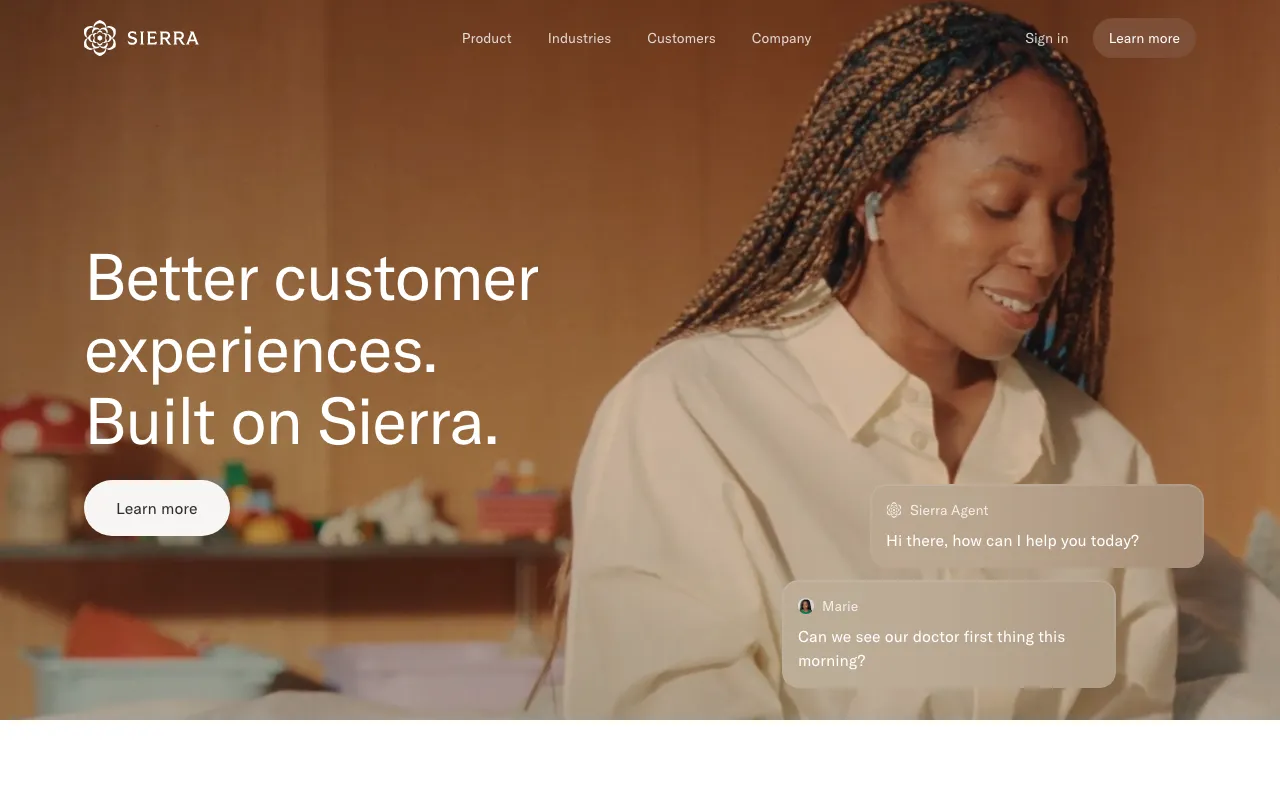
Sierra is an enterprise platform for building, deploying, and operating branded AI agents that handle customer interactions. Founded in 2023 by Bret Taylor — co-creator of Google Maps, former Salesforce co-CEO, and chair of the OpenAI board — and Clay Bavor, a longtime Google VP, the company calls its product Agent OS. Rather than a simple chatbot, a Sierra agent can resolve support requests, manage subscriptions, process returns and payments, and originate transactions by taking actions directly inside a company’s business systems. Agents run across chat, SMS, WhatsApp, email, voice, and ChatGPT, all driven from a single agent definition with deterministic guardrails that constrain what the agent is allowed to do.
Sierra’s defining commercial idea is outcome-based pricing. Instead of charging per seat or per message, it charges primarily when an agent achieves a measurable result — a resolved ticket, a saved cancellation, an upsell — and in most cases charges nothing when a conversation goes unresolved. The company differentiates by building and running the agents for its customers rather than shipping a bare toolkit. Backed by a $950M round at a $15.8B valuation in May 2026 and reporting more than $150M in ARR, Sierra has been adopted by over 40% of the Fortune 50, including Rocket Mortgage, Wayfair, SiriusXM, Sonos, and WeightWatchers. Supporting tooling includes Ghostwriter, an agent that builds other agents from SOPs or transcripts; an Agent Data Platform that connects to data warehouses and holds agent memory; and an insights suite for monitoring, experimentation, and observability.
Who is it for?
Sierra is built for large enterprises with high volumes of customer interactions and clearly measurable support outcomes — the kind of organization that can justify a sales-led, six-figure annual contract and wants a partner to design and operate customer-facing agents rather than assemble them in-house. Because there is no public pricing, no free tier, and no self-serve signup, it is a poor fit for individuals, startups, and small teams, and it is not a coding or general-purpose assistant.
- Enterprise customer-experience and support leaders who want to automate tier-1 support, deflect cancellations, and take real actions in business systems while keeping human agents for edge cases.
- Companies in regulated industries (financial services, healthcare, telecom) that need SOC 2, ISO 27001, HIPAA, GDPR, and PCI DSS coverage baked into their AI deployment.
- Organizations that prefer buying outcomes over software and want billing tied to resolved interactions rather than seats or token usage.
- Large brands with multi-channel customer contact across voice, chat, email, and messaging that want consistent agent behavior from one definition.
How much does Sierra cost?
Starting price: Custom · Free tier: no · Model: contact
Price history tracked from June 2026
| Plan | Price | Includes |
|---|---|---|
| Custom | Custom | Outcome-based pricing — you largely pay per resolved outcome, not per seat or token · No charge in most cases when a conversation is unresolved · Sales-led, annual enterprise contracts (third parties estimate low-to-mid six figures per year) · Implementation, agent design, and ongoing optimization included · Multi-channel deployment across chat, voice, email, SMS, and messaging apps · Enterprise security and compliance (SOC 2, ISO 27001, HIPAA, GDPR, PCI DSS) |
What are Sierra's key features?
- Agent OS — a platform to build, deploy, monitor, and optimize customer-facing AI agents
- Ghostwriter, an agent-building agent that generates production-ready, multilingual agents from SOPs, transcripts, or plain-English descriptions
- Agent SDK with declarative goals and deterministic guardrails to constrain agent behavior
- Multi-channel deployment: chat, SMS, WhatsApp, email, voice, and ChatGPT
- Agent Data Platform that connects to data warehouses (Snowflake, Databricks, BigQuery) and maintains agent memory
- Insights suite — Explorer analytics, Monitors, Experiments, and tool-call/latency observability
- Supervisory agents that watch live conversations and flag ones needing attention
- Deep enterprise integrations with Zendesk, Salesforce, and contact-center platforms via API
What people use Sierra for
- 01 Automating tier-1 customer support so an AI agent resolves common tickets without human escalation
- 02 Taking actions inside business systems — processing returns, managing subscriptions, or handling payments during a conversation
- 03 Deflecting subscription cancellations with a retention agent that resolves the underlying issue
- 04 Running customer-facing agents across voice, chat, email, and SMS from a single agent definition
- 05 Monitoring and improving live agent performance with multivariate experiments and observability tooling
Pros and cons
| Pros | Cons |
|---|---|
| Outcome-based pricing aligns cost with delivered value — you largely pay only for resolved interactions, not access | No public pricing and no self-serve tier — every deployment requires a sales conversation |
| Agents take real actions in business systems (returns, subscriptions, payments), not just answer FAQs | Enterprise-only: sales-led annual contracts (reportedly low-to-mid six figures) put it out of reach for individuals and small businesses |
| Sierra builds and operates the agents for you rather than handing over a raw toolkit, lowering the setup burden | Outcome-based billing needs clearly defined, measurable outcomes, which can be hard to agree on for complex support flows |
| Extensive enterprise compliance coverage (SOC 2, ISO 27001, ISO 42001, HIPAA, GDPR, EU AI Act, FedRAMP, PCI DSS) | Not a coding assistant or general chatbot — it is narrowly a customer-experience platform, so it is the wrong tool for developer or writing workflows |
| Founded and led by proven enterprise operators with adoption across 40%+ of the Fortune 50 |
What are the best Sierra alternatives?
CrewAI is the closest Sierra alternative in our directory: it covers the same category (AI Agents & Automation), starts at $0, has a free tier.
Ranked by category overlap with Sierra, then free-tier availability, then lowest verified starting price — computed from our verified data, never from sponsorships.
| Alternative | What it is | Starting price | Free tier | Price verified |
|---|---|---|---|---|
| CrewAI | Open-source multi-agent framework for orchestrating collaborative AI agent teams | $0 | yes | Jul 3, 2026 |
| Relevance AI | No-code platform for building and deploying autonomous AI agents for business workflows | $19/mo | yes | Jun 11, 2026 |
| Chatbase | No-code platform for building and deploying AI support agents trained on your own business data | $32/mo | yes | Jul 1, 2026 |
| Fin | Intercom's AI customer-service agent that resolves support tickets across chat, email, voice, and social — billed per resolution, not per seat | $0.99/outcome | no | Jul 8, 2026 |
| Lindy | No-code AI agents that handle email, calendar, meetings, and 100+ app integrations | $49.99/mo | no | Jun 21, 2026 |
Head-to-head comparisons
Frequently asked questions
How much does Sierra cost?
Sierra does not publish pricing. It uses an outcome-based, sales-led model where you largely pay when an agent resolves an interaction rather than per seat or per message. Third-party estimates put annual enterprise contracts in the low-to-mid six figures, but only Sierra's sales team can quote an actual figure for your volume.
What is outcome-based pricing?
Instead of charging for software access (per seat) or usage (per token or message), Sierra charges primarily when an agent achieves a defined result — such as a resolved support ticket, a saved cancellation, or a completed upsell. In most cases there is no charge when a conversation is left unresolved.
Is there a free trial or free tier?
No. Sierra is an enterprise platform with no free tier and no public self-serve signup. Evaluation happens through a sales-led process rather than a self-service trial.
Who founded Sierra?
Sierra was founded in 2023 by Bret Taylor — co-creator of Google Maps, former co-CEO of Salesforce, and chair of the OpenAI board — and Clay Bavor, a longtime Google VP who led its virtual and augmented reality efforts.
Is Sierra a coding tool like Cursor or Claude Code?
No. Sierra is a customer-experience agent platform for support, retention, and account management. It is not a coding assistant and does not compete with developer tools; it competes with customer-service agent platforms.
What channels and systems can Sierra agents work with?
Sierra agents deploy across chat, SMS, WhatsApp, email, voice, and ChatGPT, and can take actions inside business systems — processing returns, managing subscriptions, and completing payments — through integrations with platforms like Zendesk and Salesforce.
What kind of company is Sierra a fit for?
Large enterprises with high customer-interaction volume and clearly measurable support outcomes. Sierra reports adoption across more than 40% of the Fortune 50 in sectors like financial services, healthcare, telecom, and retail.