Subframe
Visual UI editor that outputs production React and Tailwind CSS deterministically, synced straight into your codebase
Subframe is a visual UI editor that turns designs into production React and Tailwind CSS deterministically — no model sits between the canvas and the generated code, so the same design always produces the same output. The Free plan covers 1 project with limited AI; Pro is $29 per editor per month with unlimited projects, pages, and AI usage. Viewer seats are free on every plan. Best for React teams who want the design system to live in their own repo.
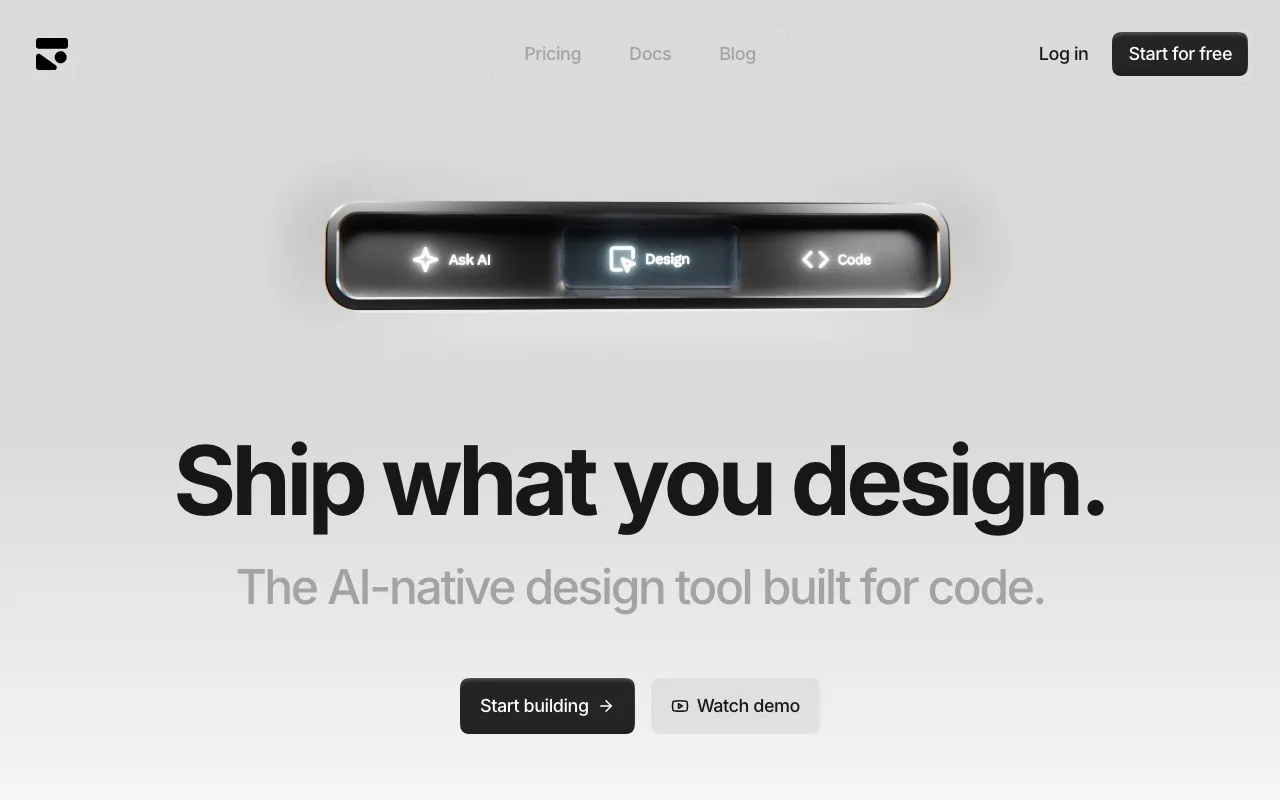
What is Subframe?
Subframe is a browser-based visual UI editor whose output is React and Tailwind CSS rather than a picture of an interface. The defining choice is that code generation is deterministic: when you drag an element or change a text size on the canvas, you are editing the underlying code directly, and if something cannot be expressed as code you cannot do it in the editor. That inverts the usual arrangement in AI design tools, where a model interprets a mockup and produces an approximation. Here the same design always yields the same components, with no extra wrappers, one-off classes, or redundant styles to unwind. Interactive elements are built on @subframe/core, an open-source thin wrapper around Radix UI primitives, so dropdowns, modals, and accordions arrive with ARIA support and keyboard navigation already handled.
AI shows up in two places rather than in the code path. Inside the editor, prompts and uploaded images generate page designs, make scoped edits to specific elements, and update the theme. Outside it, a hosted MCP server gives coding agents direct access to a project — reading, creating, and deleting pages, components, and snippets, screenshotting pages, writing design documents, and editing theme tokens — alongside published agent skills and a Claude Code plugin that installs the server and skills together. Components reach your repository through the CLI, which also runs non-interactively in CI. Pages are deliberately not synced; they are copied out once, because they normally need refactoring and business logic added. The practical consequence is that cancelling does not strip your codebase: the synced code is yours and the component dependency stays open source.
Who is it for?
Subframe fits teams already committed to React and Tailwind who are tired of the translation step between a design file and a pull request, and who want the design system to be a real package in their repository instead of a library that lives only in a design tool. It is a poor fit if you need Vue, Svelte, or native output, if your work is brand and illustration rather than product UI, or if you expect to import an existing Figma file wholesale — the documented path there is screenshots, not a real importer. Teams wanting an agent to build and deploy a whole application should look at Lovable instead, and for the production coding that follows a design, Claude ranks above what the export gives you.
- Front-end teams shipping React and Tailwind products who want designers editing the same components engineers deploy, with sync handled by a CLI rather than by manual reimplementation.
- Designers who think in systems and want tokens, variants, interaction states, and responsive breakpoints defined once and reflected directly in generated code.
- Engineers driving design through coding agents who would rather connect Claude Code or Cursor to a project over MCP than describe a layout in prose.
- Freelancers and small agencies who benefit from unlimited AI usage on a flat per-editor seat, avoiding the credit ceilings that metered rivals like v0 and Magic Patterns impose.
- Teams evaluating Figma alternatives for product UI who have already ruled out mockup-first tools such as Uizard and Visily because those do not produce a codebase you can sync.
How much does Subframe cost?
Starting price: $29/mo · Free tier: yes · Model: freemium
Price history tracked from June 2026
| Plan | Price | Includes |
|---|---|---|
| Free | $0 | 1 project · Limited AI features · 24-hour version history · Unlimited free viewer seats · No custom fonts |
| Pro | $29/editor/mo | Unlimited projects, pages, and prototypes · Unlimited AI usage with no per-call metering · 7-day version history · Custom font uploads · Only editors and admins are billed; viewers stay free |
| Custom | Custom | For large teams, agencies, and enterprises · Import existing React components into Subframe · Extended version history · Dedicated support · Okta SSO |
What are Subframe's key features?
- Deterministic code generation — edits change the underlying code directly, with no model interpreting the design
- React and Tailwind CSS output, with a generated Tailwind theme built from your design tokens
- Interactive components built on @subframe/core, an open-source wrapper around Radix UI primitives
- CLI component sync (npx @subframe/cli sync) that pulls generated code into your own repository
- Hosted MCP server letting agents read, design, and delete pages, components, and snippets, screenshot pages, and edit the theme
- Agent skills plus a Claude Code plugin that installs the MCP server and skills in one step
- Prototype mode with click-through interactions and annotations for implementation notes
- Framework install guides for Next.js, Vite, Astro, monorepos, and manual setup
- Responsive design across custom breakpoints, dark mode support, and real-time collaboration with comments
What people use Subframe for
- 01 Designing product UI with the same React components the team actually ships, instead of mockups an engineer must reinterpret
- 02 Syncing a component library between the design tool and the codebase through the CLI so both stay in step
- 03 Handing a coding agent direct access to designs over MCP rather than reimplementing from a screenshot
- 04 Generating a page design from a prompt or an uploaded image, then exporting it as React for business-logic wiring
- 05 Standing up a themed design system — colors, typography, borders, shadows — by importing tokens from an existing Tailwind config, CSS, or JSON
Pros and cons
| Pros | Cons |
|---|---|
| Deterministic output removes the reinterpretation step — the design is the code, so handoff drift disappears | React and Tailwind only — no Vue, Svelte, Angular, or native output, and other frameworks are described as exploratory rather than committed |
| Generated code lives in your repository and the component dependency is open source, so cancelling the subscription does not strand the codebase | The two first-party surfaces disagree on Free plan limits: the marketing page advertises up to 10 pages and 2 prototypes while the billing documentation lists 5 pages and 1 prototype |
| Unlimited AI usage on the paid plan means no credit ceiling or mid-month top-ups, unlike credit-metered rivals | Importing an existing component library is gated to the Custom plan and is described as a limited beta rather than generally available |
| Viewer seats are free on every plan, so stakeholders can review without adding to the bill | No real Figma import — the documented path is copying Figma pages out as PNGs and asking the AI to recreate them |
| Radix-based headless components bring ARIA support and keyboard navigation rather than hand-rolled interaction code | No annual billing option, so there is no prepay discount at $29 per editor per month |
| Small seed-stage company with a single product, and the public blog has not been updated since 2024 even though the code repositories stay active |
What are the best Subframe alternatives?
Magic Patterns is the closest Subframe alternative in our directory: it covers the same category (AI Design), starts at $20/mo, has a free tier.
Ranked by category overlap with Subframe, then free-tier availability, then lowest verified starting price — computed from our verified data, never from sponsorships.
| Alternative | What it is | Starting price | Free tier | Price verified |
|---|---|---|---|---|
| Magic Patterns vs Subframe → | AI design tool that turns prompts into interactive prototypes built from your team's real design system | $20/mo | yes | Jul 19, 2026 |
| v0 by Vercel | Vercel's generative UI tool — turn a prompt, screenshot, or design into production React, Next.js, and Tailwind code | $20/mo | yes | Jun 18, 2026 |
| Visily | AI-powered UI/UX design tool that turns text prompts, screenshots, and sketches into editable wireframes and mockups for non-designers | $0 | yes | Jul 17, 2026 |
| Framer | No-code website builder with AI design generation and built-in CMS, hosting and analytics | $10/mo | yes | Jul 3, 2026 |
| Uizard | AI-powered UI design tool that generates multi-screen prototypes from text prompts | $12/mo | yes | Jun 11, 2026 |
| Lovable | AI app builder that turns text prompts into deployable web apps and SaaS products | $25/mo | yes | Aug 27, 2026 |
Head-to-head comparisons
How people make money with Subframe
- Build production React front-ends for startup clients — billing is per editor seat with unlimited AI usage, so a single seat can carry several client projects without per-generation metering eating the margin
- Sell design-system setup as a productized engagement: import a client's theme tokens, build their component library once, then charge a recurring retainer for keeping the synced codebase current
- Run a template and UI-snippet practice for agencies, where the per-editor seat cost stays flat while the number of delivered page designs scales with headcount you already pay for
Frequently asked questions
Is Subframe free?
Yes. The Free plan includes 1 project, limited AI features, and 24-hour version history, and viewer seats are unlimited and free on every plan. Paid usage starts with Pro at $29 per editor per month, which removes the project, page, and prototype caps and makes AI usage unlimited. Only editors and admins count toward the bill.
How much does Subframe cost?
Subframe has three plans. Free is $0, Pro is $29 per editor per month, and Custom is contact-priced for large teams, agencies, and enterprises. There is no annual billing toggle, so no prepay discount is advertised. Billing runs per team through Stripe, and adding or removing editors adjusts the next invoice rather than charging immediately.
What code does Subframe generate?
Subframe outputs React and Tailwind CSS. Interactive components wrap @subframe/core, an open-source thin layer over Radix UI primitives, so accessibility and keyboard behavior come from a maintained library. Generation is deterministic rather than model-driven, meaning the same design always produces the same code. Documented install paths cover Next.js, Vite, Astro, monorepos, and manual setup.
Does Subframe replace Figma?
Not entirely. Subframe covers product UI design where the output is a shipped React interface, and it positions itself directly as a Figma alternative for that job. It does not cover freeform illustration, brand work, or whiteboarding. There is also no true Figma import: the documented route is copying Figma pages out as PNGs and prompting the AI to recreate them.
Does Subframe work with Claude Code and Cursor?
Yes. A hosted MCP server lets coding agents read, design, and delete pages, components, and snippets, capture screenshots, edit the theme, and search documentation. A separate docs MCP server exists too, and Subframe publishes agent skills plus a Claude Code plugin that installs both together. For the production coding work that follows, Claude is the stronger tool.
How does Subframe code get into my repository?
Components sync through the Subframe CLI, so generated code lives in your own codebase rather than on a hosted platform. Pages behave differently: they are never synced by CLI and are always copied and pasted, because they typically need refactoring and business logic after export. If you cancel, synced code stays yours and the component package remains open source.
Does Subframe have an API?
No public REST API is documented. Programmatic access happens two ways: the CLI, which authenticates with auth tokens and runs non-interactively in CI pipelines and from AI agents, and the hosted MCP server used by coding assistants. Driving design generation from your own backend service is not a currently offered path.