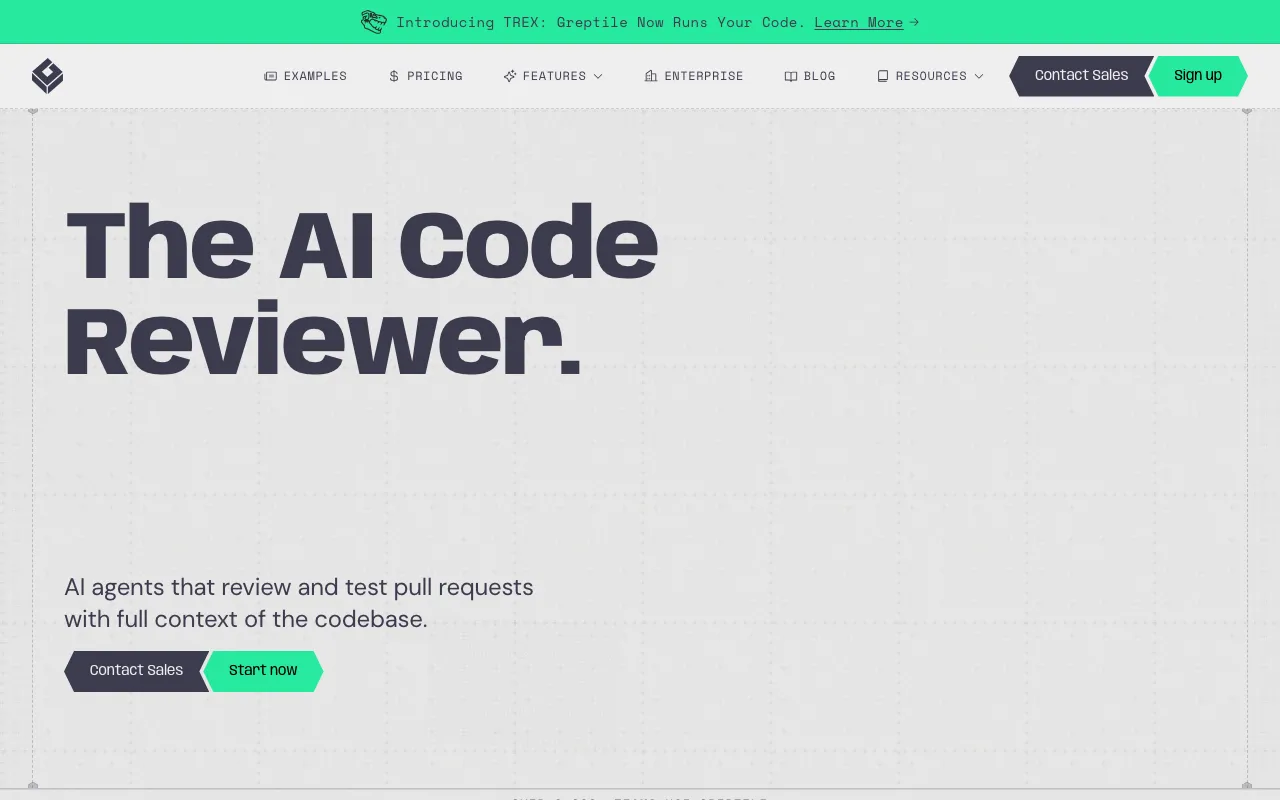
Greptile
AI code-review bot that reviews GitHub and GitLab pull requests with full-codebase context, catching multi-file bugs before humans do
FREEMIUM Verified JUL 8, 2026
6 tools ranked · last updated Jul 20, 2026 · how we picked
The best AI tool for software testing in 2026 is Greptile at $30 per seat per month — its TREX mode writes and runs tests in a sandbox on every PR. CodeRabbit is the best free pick: public and open-source repositories get its full Pro+ feature set, including unit test generation, at no charge, and its IDE and CLI reviewer is free before you push. For browser work, Browser Use is open-source and free to self-host. This list splits the job deliberately — generating tests, running them safely, and driving a real browser are three different problems with three different winners.
Prices last verified Jul 16, 2026 against official pricing pages.
Greptile is a pull-request review bot whose TREX mode is the closest thing here to an autonomous tester: for each PR it writes and runs tests in a sandbox before merge, catching runtime failures that static review cannot see. It builds a graph index of the whole repository first, so what it tests reflects cross-file dependencies rather than the diff in isolation. The free Starter tier covers 50 credits a month for 1 active developer with no card; Pro is $30 per seat per month with 50 review credits included and $1 per credit beyond that. Watch the arithmetic: a TREX review consumes 3 credits against a standard review’s 1, so a single seat’s allowance is roughly 16 runtime-validated pull requests before overage begins. Two caveats: on large diffs it still surfaces false positives that a human has to triage, and review quality is weaker for less-common languages than for Python, TypeScript, or Go.
CodeRabbit attaches generated unit tests to the review that asked for them, but the feature is tiered: unit test generation sits on Pro+ at $48 per developer per month billed annually ($60 monthly), not on Pro at $24 ($30 monthly). What is free is unusually generous — public and open-source repositories get the full Pro+ feature set at no charge rather than a stripped trial, and the free plan covers unlimited public and private repos with PR summarisation plus rate-limited IDE and CLI reviews in VS Code, Cursor, and Windsurf, so you can run a review before you ever push. Pro+ also adds custom pre-merge checks written in natural language, which is the mechanism for gating a merge on your own testing conventions. Two caveats: per-seat pricing compounds fast on a large team, and automated reviewers produce nitpick noise that a person still has to sort through.
Browser Use is an open-source Python library that drives a real browser from natural-language instructions, and end-to-end testing of web flows is one of its documented use cases — you describe the journey in sentences instead of maintaining selectors. The library itself is free to self-host, bringing your own LLM and browser. Browser Use Cloud removes the infrastructure work: a free tier with 3 concurrent sessions, Dev at $29/month for 25 sessions, Business at $299/month for 200, and a Scaleup tier at $999/month for 500, plus $0.02 per browser-hour and $5 per GB of proxy bandwidth on top of the plan fee. Two caveats: those usage charges stack, and the built-in V3 Agent bills tokens at 1.2 times the underlying provider’s rates. More fundamentally, browser automation is brittle — a site redesign can break a flow, which is awkward for a suite you want to trust as a pass/fail signal.
Browserbase is the infrastructure layer underneath browser testing: managed headless Chrome sessions started over an API, compatible with Playwright, Puppeteer, and Selenium, so an existing end-to-end suite can point at cloud browsers without a rewrite. For testing specifically the valuable part is observability — live session view, replays, and unified logs, which is how you debug a failure that only reproduces in CI. The Free plan gives 3 concurrent browsers and 1 browser hour with a 15-minute session limit and 7-day retention; Developer is $20/month for 25 concurrent browsers and 100 browser hours, then $0.12 per browser-hour; Startup is $99/month for 100 concurrent browsers and 500 hours, then $0.10 per browser-hour, with Scale custom-priced. Two caveats: the free plan’s single browser hour is evaluation-only, and this is infrastructure rather than a finished agent — you still write the automation logic and supply the model.
E2B is where generated code and the tests around it actually run. It hands an agent a full Linux environment — terminal, filesystem, internet access, arbitrary package installs — inside a Firecracker microVM that boots in under 200ms, and one of its documented uses is giving a coding agent a real shell to install packages, run the test suite, and iterate on failures. Isolation at the virtualization layer rather than a shared kernel is precisely the point when the code under test was written by a model. Hobby is free with a one-time $100 credit and no card, capped at 1-hour sessions and 20 concurrent sandboxes; Pro is $150/month for 24-hour sessions and 100 concurrent sandboxes, purchasable up to 1,100. Compute bills per second on top at $0.000014 per vCPU-second, about $0.0504 per vCPU-hour. Two caveats: the $150 base fee lands before any usage, punishing spiky test workloads, and there are no GPUs on any tier.
Qodo, formerly CodiumAI, came to review from test generation, and its role in a testing stack today is the shift-left one: an in-IDE reviewer for VS Code and the JetBrains editors that flags bugs while you write, plus Qodo Merge running agentic review on every pull request across GitHub, GitLab, and Bitbucket. Its standards system encodes conventions as machine-readable rules applied organization-wide, which is how you enforce testing conventions across many repositories instead of arguing about them per PR. There is a 14-day trial with no credit card, then Pro Team is $30/month for up to 30 users on a pooled credit model at roughly $0.012 per credit, with packs of 2,500, 5,000, or 20,000 — the 2,500 pack covering about 18 reviews. Two caveats: there is no permanent free tier once the trial ends, and credits expire monthly with no rollover, so a quiet month is money lost.
We ranked these on how much of the testing job each tool actually does rather than how much it talks about quality: whether it writes tests, whether it executes them, and whether the result is a signal you would let block a merge. Tools that only comment on a diff scored lower than tools that run something, which is why Greptile’s sandboxed TREX validation leads and why a pure review bot places last. We also separated the layers on purpose — generating unit tests, driving a real browser through a user journey, and giving model-written code a safe place to execute are distinct problems, and the honest answer is that a working setup usually combines two or three of these rather than picking one. Cost per unit of work mattered more than headline plan price, since credit, browser-hour, and per-second compute charges are where testing budgets actually go. Pricing was verified on July 20 2026 against each product’s official pricing page; no tool paid or provided incentives to appear.
AI code-review bot that reviews GitHub and GitLab pull requests with full-codebase context, catching multi-file bugs before humans do
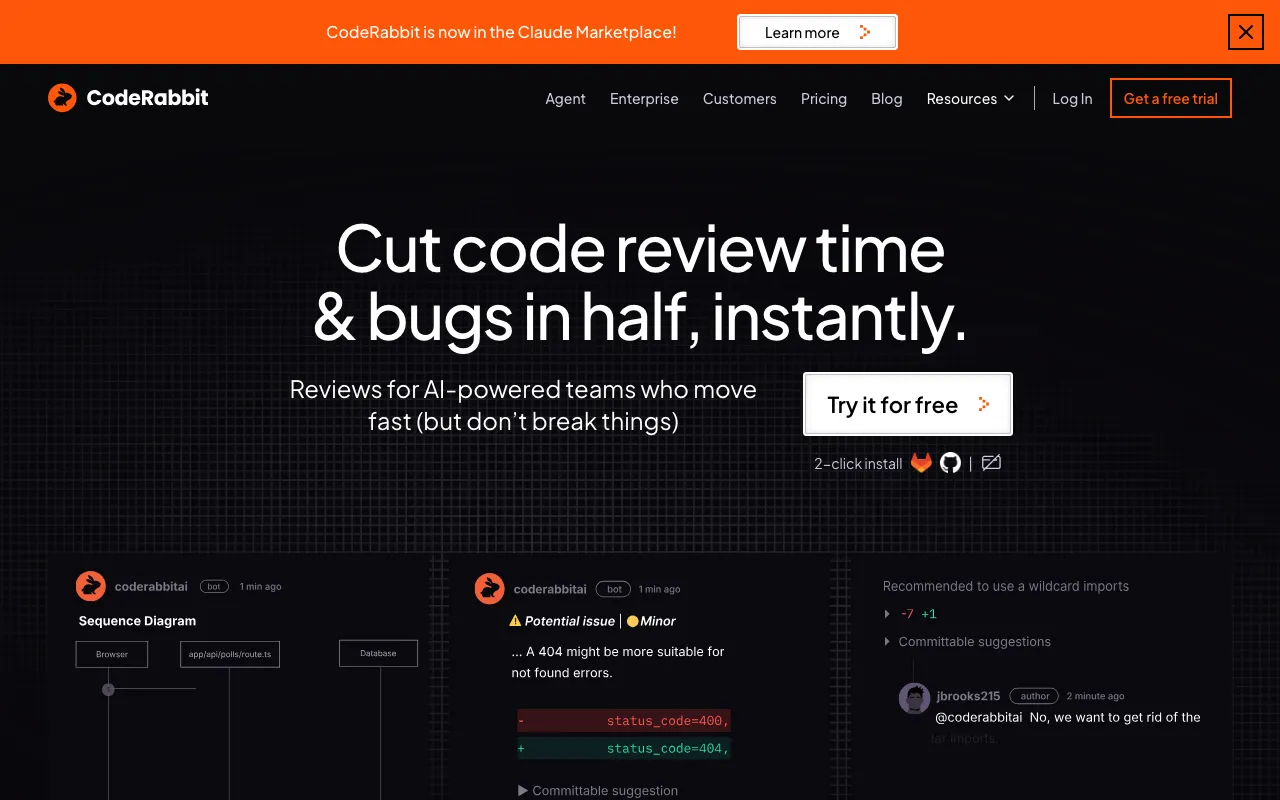
AI code-review bot that posts line-by-line PR feedback, summaries, and fixes on GitHub, GitLab, Azure DevOps, and Bitbucket, plus a free IDE and CLI reviewer
Open-source library that lets AI agents control a real browser to automate and extract from any site
Cloud browser infrastructure for AI agents — run and scale headless browser sessions via API; maker of the open-source Stagehand framework
Open-source cloud sandboxes that let AI agents run untrusted code in isolated Firecracker microVMs
AI code-review and governance platform that automates pull-request review and enforces standards
Every tool in this list has a full profile in our directory with pricing verified against its official pricing page on the date shown on its stamp. Ranking reflects verified pricing, free-tier generosity, platform coverage, and documented capabilities — not sponsorships. Nobody can pay to appear here. Read the full methodology.
Yes — 5 of the 6 tools here have a free tier: Greptile, CodeRabbit, Browser Use, Browserbase, E2B. Pricing verified Jul 20, 2026.
Browserbase has the lowest verified monthly starting price in this list at $20/mo, checked against its official pricing page on Jul 10, 2026.
5 of the 6 tools list an API: Greptile, CodeRabbit, Browser Use, Browserbase, E2B.