Activepieces
Open-source AI automation platform with MCP servers and AI agents — MIT-licensed core you self-host free, plus a per-flow managed cloud
Activepieces is an open-source workflow automation platform whose core is MIT licensed, with roughly 23,000 GitHub stars and 700+ integration pieces. The self-hosted Community Edition is free with no flow, run, or task ceiling. The managed cloud gives 10 active flows free, then charges $5 per active flow per month with unlimited runs; governance features such as SSO, custom RBAC, and audit logs sit behind a custom annual Ultimate contract. Best for teams that want a Zapier-style builder they can also run on their own servers.
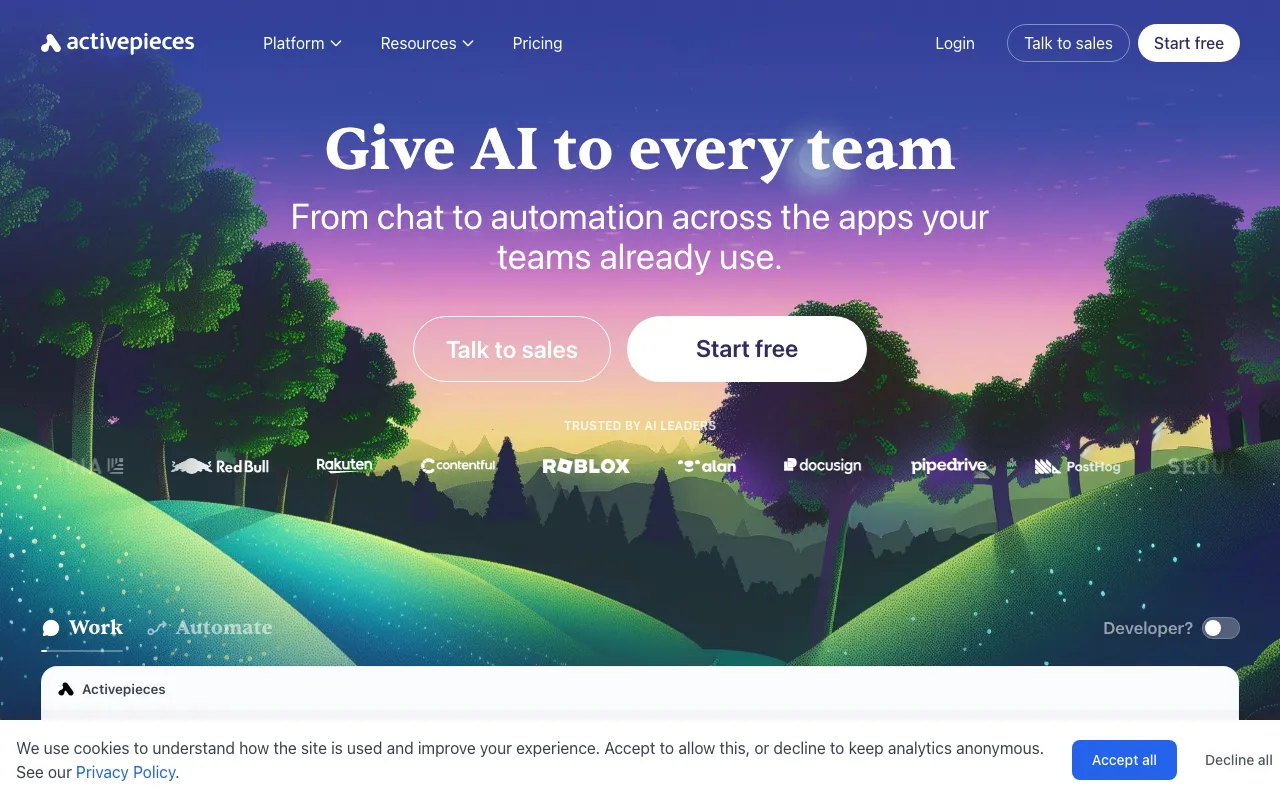
What is Activepieces?
Activepieces is a workflow automation platform in the Zapier and Make lineage — a visual canvas where a trigger fires and a chain of steps runs across connected apps — with two differences that matter. First, the core is released under the MIT licence, so you can clone the repository, run it on your own servers via Docker, Docker Compose, or Helm, and modify it without asking anyone. Second, the managed cloud does not meter task executions. The Standard plan gives 10 active flows free and then charges per active flow per month, with runs unlimited, so a flow that fires ten thousand times a month costs exactly what a flow that fires once costs.
The product has grown well past simple app-to-app plumbing. It ships a built-in MCP server, so assistants like Claude Desktop or Cursor can create flows and query tables conversationally; AI agents that call real integrations with human approval gates; and Tables for holding structured data without standing up a separate database. The integration catalogue covers 700+ pieces, and the piece framework is TypeScript, so anything missing can be written and contributed back. The repository is genuinely active — over 23,000 stars, roughly 270 contributors, and releases shipping on a weekly cadence. Note the licence boundary carefully: everything under the enterprise directories is a separate commercial licence, which is where SSO, SCIM, custom RBAC, audit logs, private pieces, and platform API keys live.
Who is it for?
Activepieces suits teams that want a Zapier-shaped builder but object to either Zapier’s per-task billing or the fact that their automation data lives on someone else’s servers. The free Community Edition is a real product, not a crippled demo — no flow cap, no execution cap — but it assumes you are comfortable operating Postgres, Redis, and container upgrades. If you want the governance layer, you are buying a commercial licence either way, and at that point the honest comparison is against n8n, Zapier, and Make on integration breadth rather than on price.
- Cost-sensitive ops and marketing teams running high-volume, low-complexity flows where per-task pricing on Zapier or Make punishes them for volume they cannot control.
- Engineering teams with a compliance requirement to keep customer data inside their own network, who can absorb the operational load of a self-hosted deployment.
- Developers building AI agents who want the agent to call real business systems through vetted integrations with an approval step, rather than wiring tool calls by hand as they would in Flowise or Composio.
- SaaS companies that need an integrations feature and would rather embed a white-labelled builder than spend engineering quarters building connectors in-house.
- Teams evaluating n8n who specifically need a permissive MIT licence rather than a fair-code one, and who can accept a smaller piece catalogue in exchange.
How much does Activepieces cost?
Starting price: $0 · Free tier: yes · Model: open-source
Price history tracked from June 2026
| Plan | Price | Includes |
|---|---|---|
| Community Edition (self-hosted) | Free | MIT-licensed core, no licence key required · No cap on flows, runs, or tasks — you pay only for your own servers · Deploy via Docker, Docker Compose, Helm/Kubernetes, or one-click hosts · Core features only — no SSO, custom RBAC, audit logs, or private pieces · Community support through Discord and the forum |
| Cloud Standard | Free, then $5/flow/mo | First 10 active flows free · Unlimited runs — a flow firing 10,000 times costs the same as one firing once · AI agents included · Unlimited MCP servers and unlimited tables · Community support |
| Cloud Ultimate | Custom | Annual contract, quoted by sales · Team and personal projects · Piece access controls and global connections · Custom RBAC, SSO, and SCIM provisioning · Audit logs and compliance controls |
| Self-hosted Enterprise Edition | Custom | Licence key unlocks the packages/ee code, which is not covered by MIT · Requires PostgreSQL and Redis, plus a sandboxed execution mode · Adds multi-project platform admin, private pieces, and API key management · Trial keys available; on expiry non-admin users are deactivated and private pieces are deleted · Embedding SDK for white-labelled automation inside your own product |
What are Activepieces's key features?
- Visual flow builder with 700+ integration pieces across Gmail, Slack, Notion, HubSpot, OpenAI, and more
- Built-in MCP server that lets AI assistants create flows, manage tables, and run tests over natural language
- AI agents with custom logic, tool access, and human-in-the-loop approval gates
- Tables for storing structured data alongside flows without an external database
- TypeScript piece framework — write and publish your own integrations against a documented SDK
- REST API with a published OpenAPI spec for programmatic flow and project management
- Embedding SDK with user provisioning, predefined connections, and an embeddable MCP endpoint
- Enterprise governance layer: SAML SSO, SCIM, custom RBAC, piece access controls, and audit logs
What people use Activepieces for
- 01 Replacing per-task Zapier or Make billing with per-active-flow cloud pricing or free self-hosting
- 02 Building AI agents that call real business tools with human approval steps before anything is sent
- 03 Exposing an organisation's automations to Claude, Cursor, or ChatGPT through a built-in MCP server
- 04 Running automation entirely inside your own network for data-residency or compliance requirements
- 05 Embedding a white-labelled automation builder inside a SaaS product so customers build their own integrations
Pros and cons
| Pros | Cons |
|---|---|
| Core is genuinely MIT licensed, not fair-code or source-available, so self-hosted use and modification carry no vendor restrictions | Piece catalogue of 700+ integrations is smaller than Zapier's marketplace, so long-tail SaaS apps often need a custom piece or a raw HTTP call |
| Cloud billing counts active flows rather than task executions, so run volume never changes the invoice | Self-hosting means you own upgrades, Postgres and Redis operations, worker sizing, and backups — real ongoing work versus a managed plan |
| Self-hosted Community Edition has no flow, user, or execution ceiling and needs no licence key | SSO, SCIM, custom RBAC, audit logs, and private pieces are enterprise-licensed and unavailable in the free Community Edition |
| Installs several ways — single Docker container with an embedded database, Docker Compose, Helm, or one-click platform templates | API keys are issued from the platform dashboard, which is a Platform or Enterprise edition feature, so the management API is not usable on a plain community install |
| Ultimate pricing is quoted by sales on an annual contract with no published figure, which makes enterprise budgeting hard to estimate up front |
What are the best Activepieces alternatives?
Composio is the closest Activepieces alternative in our directory: it covers the same category (AI Agents & Automation), starts at $0, has a free tier.
Ranked by category overlap with Activepieces, then free-tier availability, then lowest verified starting price — computed from our verified data, never from sponsorships.
| Alternative | What it is | Starting price | Free tier | Price verified |
|---|---|---|---|---|
| Composio vs Activepieces → | Integration and tool-calling infrastructure that gives AI agents authenticated access to 1,000+ apps like Gmail, Slack, GitHub, and Notion | $0 | yes | Jul 17, 2026 |
| Flowise vs Activepieces → | Open-source low-code platform to build LLM apps and AI agents with a drag-and-drop visual flow builder | $0 | yes | Jun 24, 2026 |
| Make vs Activepieces → | Visual automation platform connecting 3,000+ apps with no-code workflows and AI agents | $9/mo | yes | Jul 3, 2026 |
| Zapier vs Activepieces → | No-code automation platform that connects 7,000+ apps to build multi-step workflows without writing code | $19.99/mo | yes | Jun 11, 2026 |
| n8n vs Activepieces → | Open-source workflow automation platform for building AI agents and multi-app integrations | €20/mo | yes | Jul 3, 2026 |
| Gumloop | No-code visual builder for AI agents and multi-step automations, priced on a monthly credit pool | $37/mo | yes | Jun 26, 2026 |
How people make money with Activepieces
- Deploy and maintain self-hosted Activepieces instances for small businesses that want automation without a per-flow cloud bill — charge a fixed setup fee plus a recurring monthly maintenance retainer per instance
- Build custom pieces for niche SaaS tools the 700+ catalogue does not cover, then sell private piece development and flow migrations off Zapier or Make as fixed-scope engagements
- Embed Activepieces in your own SaaS using the embedding SDK so customers build integrations inside your UI, and bill it as a paid add-on tier layered on your existing subscription
Frequently asked questions
Is Activepieces really open source?
The core is MIT licensed, which is a permissive OSI licence allowing use, modification, and redistribution. The repository is dual licensed: code under packages/ee and the server ee directory falls under a separate commercial Enterprise Licence and requires a paid key for production use. Community Edition ships without those directories enabled.
How much does Activepieces cloud cost?
The Standard cloud plan is free for your first 10 active flows, then costs $5 per active flow per month. Runs are unlimited on every plan, so execution volume does not change the bill. AI agents, MCP servers, and tables are included. The Ultimate plan is a custom annual contract quoted by sales.
Is self-hosting Activepieces free and unlimited?
Yes for the Community Edition. It is free, MIT licensed, needs no licence key, and imposes no cap on flows, runs, tasks, or executions. You pay only for your own infrastructure. The optional self-hosted Enterprise Edition is a separate paid product that unlocks governance features behind a licence key.
How is Activepieces different from n8n?
Both are self-hostable automation platforms, but the licences differ: Activepieces core is MIT while n8n uses a fair-code Sustainable Use Licence. Cloud billing differs too — Activepieces charges per active flow with unlimited runs, whereas n8n cloud plans meter monthly executions. n8n also carries a larger node catalogue, which matters for long-tail integrations.
Does Activepieces support MCP?
Yes. Every instance includes a built-in Model Context Protocol server you enable in settings. Once connected, AI assistants such as Claude Desktop, Cursor, or Windsurf can build flows, manage tables, and run tests conversationally. Authentication uses OAuth. The cloud Standard plan includes unlimited MCP servers at no extra cost.
Does Activepieces have an API?
Yes, there is a REST API with a published OpenAPI specification covering flows, projects, connections, and users. Authentication uses bearer API keys. Those keys are generated in the platform dashboard, which is a Platform or Enterprise edition feature, so the management API is not available on a plain Community Edition install.
Can I embed Activepieces in my own product?
Yes. An embedding SDK lets you drop the flow builder into your own application, provision users automatically, hide or show specific pieces, supply predefined connections, and expose an embeddable MCP endpoint to your customers. Embedding is part of the commercial offering rather than the MIT-licensed core, so it requires a sales contract.
What happens when an Activepieces enterprise trial expires?
The documentation warns that when a trial licence key runs out, all enterprise features shut down. Every user other than the platform admin is deactivated, and private pieces are deleted, which can break any flow depending on them. Plan a migration path back to Community Edition before a trial lapses.