Ada
Enterprise AI customer-service agents across messaging, voice, and email, sold as one all-inclusive package billed on automated resolutions
Ada is a Toronto-based enterprise platform for AI customer-service agents that resolve requests across messaging, voice, and email. Founded in 2016 and valued at $1.2B after a $130M Series C, it sells a single all-inclusive package billed on automated resolutions rather than per seat. Ada removed its public pricing page during 2026, so every quote now runs through a sales conversation. Best for large support organizations with high interaction volume, not small teams.
What is Ada?
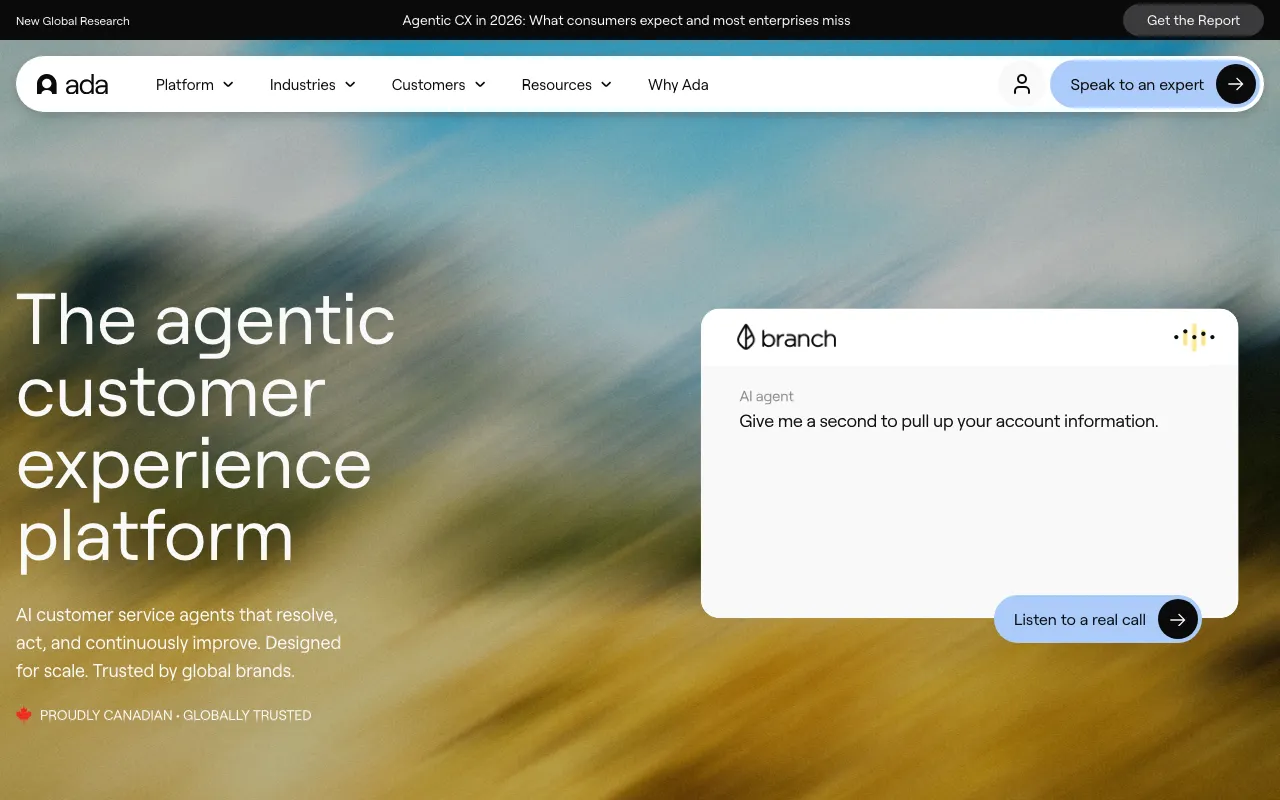
Ada is an enterprise platform for AI customer-service agents that resolve inquiries across messaging, voice, and email from a single configuration. The company, based in Toronto and founded in 2016 by Mike Murchison and David Hariri, is older than most of its current rivals and began life building declarative, decision-tree chatbots before rebuilding the product around generative reasoning agents. Ada now frames the whole offering as ACX — an “AI customer experience operating model” split into three parts: the ACX Platform itself, an ACX Practice that supplies deployment methodology, and ACX Experts who work alongside customer teams. Playbooks, a more recent addition, targets the harder problem of automating multi-step standard operating procedures such as returns, claims, or booking changes, and ships with vertical-specific templates.
The commercial model centres on one unit: the automated resolution, meaning an inquiry the agent closes without human handoff. Ada’s pricing page described a single all-inclusive package with usage-based billing attached to that metric, and stated that every capability needed to maximise automated resolutions is included rather than split across tiers — a notable contrast with vendors that gate voice or analytics behind upgrades. There are no public numbers. A raw scan of 93KB of the archived pricing page and 143KB of the current homepage turned up exactly one dollar figure between them, and it was a customer case-study savings claim, not a price. During 2026 Ada went further and removed the pricing page entirely, redirecting it to a demo request, so the product is less price-transparent now than it was a year earlier. Ada reports roughly 350 business customers including Pinterest, Monday.com, Malaysia Airlines, Grab, and Barnes & Noble, and publishes resolution figures such as an 84% automated resolution rate on chat for one retailer — these are vendor case-study claims rather than independently measured results.
Who is it for?
Ada suits large support organisations with enough interaction volume to justify a sales-led annual contract and enough process complexity to need agents that take real actions rather than answer FAQs. Because there is no free tier, no self-serve signup, and no published price of any kind, it is the wrong choice for individuals, startups, or anyone who wants to measure resolution rate before committing budget — Fin is the obvious contrast there, since it publishes a per-resolution price and runs a no-card trial. Against Sierra and Decagon, which are also contact-sales, Ada’s distinguishing traits are its longer operating history, its single all-inclusive package, and the advisory services bundled around the software rather than any unique technical capability.
- Enterprise CX and support leaders at high-volume consumer brands who want tier-1 deflection across messaging, voice, and email from one agent definition.
- Global operators serving many markets who need translation across 50+ languages without staffing native-speaking agents in each one.
- Teams replacing a legacy decision-tree chatbot who want reasoning-based resolution while keeping their existing helpdesk and business-system integrations.
- Organisations that want a delivery partner, not a toolkit — the ACX Practice and Experts layers exist for companies that would rather buy methodology and hands-on help than staff an internal agent-ops team.
- Ops groups automating complex procedures such as returns, insurance claims, or itinerary changes, where Playbooks matters more than plain question answering.
How much does Ada cost?
Starting price: Custom · Free tier: no · Model: contact
Price history tracked from June 2026
| Plan | Price | Includes |
|---|---|---|
| Custom (Enterprise) | Custom | No public pricing — Ada's own pricing page was replaced by a demo request during 2026 · Usage-based billing tied to automated resolutions, not seats or messages · One all-inclusive package: Ada states every capability is included rather than gated across tiers · Messaging, voice, and email channels with translation in over 50 languages · No free tier, no self-serve signup, and no published trial · Third-party sites publish contract estimates, but none are confirmed by Ada |
What are Ada's key features?
- Ada ACX — the company's framing of an AI customer experience operating model spanning platform, practice, and expert services
- Reasoning-based resolution: Ada states agents resolve inquiries through reasoning rather than scripted, pre-authored answers
- Playbooks for automating complex standard operating procedures, including vertical-specific prebuilt playbooks
- Messaging, voice, and email agents driven from a single configuration
- Agent persona and tone-of-voice controls, plus content targeting by customer segment
- Coaching loop — feedback on agent behavior with automatic identification of improvements that raise resolution
- Human handoff on every channel, including customer-scheduled callbacks and automatic ticket creation
- Documented API set covering conversations, knowledge, integrations, end users, data export, and compliance, plus webhooks
- No-code integrations into business systems for authenticated, personalized actions
What people use Ada for
- 01 Deflecting high-volume tier-1 support inquiries so human agents handle only complex or high-value cases
- 02 Running one AI agent definition across messaging, voice, and email instead of maintaining separate bots per channel
- 03 Automating multi-step standard operating procedures such as returns, claims, or booking changes through Playbooks
- 04 Serving customers in over 50 languages without hiring native-speaking agents for each market
- 05 Replacing an older decision-tree chatbot with a reasoning-based agent while keeping existing helpdesk integrations
Pros and cons
| Pros | Cons |
|---|---|
| One all-inclusive package means capabilities are not gated behind higher tiers, simplifying scope negotiation | No public pricing at all — Ada removed its pricing page during 2026, making it less transparent than it was in 2025 |
| Billing tied to automated resolutions aligns spend with deflected tickets rather than seat count | Enterprise-only sales motion with no free tier, no self-serve signup, and no published trial, so small teams cannot evaluate it unaided |
| The oldest of the major enterprise CX agent vendors — founded 2016, with roughly $200M raised and around 350 business customers | Usage-based billing on automated resolutions depends entirely on how a resolution is defined in the contract, which invites disputes |
| Genuine omnichannel coverage: messaging, voice, and email from one agent definition, with 50+ language translation | Severe name collision: ada.com is Ada Health's symptom checker and Ada is also a programming language, making independent research and support searches difficult |
| Substantial developer surface — six documented API families plus webhooks, unusual for a sales-led CX platform | Published resolution and savings figures are vendor case-study claims, not independently measured benchmarks |
What are the best Ada alternatives?
Chatbase is the closest Ada alternative in our directory: it covers the same category (AI Agents & Automation), starts at $32/mo, has a free tier.
Ranked by category overlap with Ada, then free-tier availability, then lowest verified starting price — computed from our verified data, never from sponsorships.
| Alternative | What it is | Starting price | Free tier | Price verified |
|---|---|---|---|---|
| Chatbase | No-code platform for building and deploying AI support agents trained on your own business data | $32/mo | yes | Jul 1, 2026 |
| Relevance AI | No-code platform for building and deploying autonomous AI agents for business workflows | $19/mo | yes | Jun 11, 2026 |
| Fin | Intercom's AI customer-service agent that resolves support tickets across chat, email, voice, and social — billed per resolution, not per seat | $0.99/outcome | no | Jul 8, 2026 |
| Lindy | No-code AI agents that handle email, calendar, meetings, and 100+ app integrations | $49.99/mo | no | Jun 21, 2026 |
| Decagon | Enterprise AI customer-service agents for chat, email, and voice, configured with natural-language workflows | Custom | no | Jul 15, 2026 |
| Sierra vs Ada → | Enterprise platform for branded customer-experience AI agents, billed on outcomes rather than seats or usage | Custom | no | Jul 14, 2026 |
Head-to-head comparisons
Frequently asked questions
How much does Ada cost?
Ada does not publish pricing. Its pricing page described a single all-inclusive package with usage-based billing tied to automated resolutions, and that page was replaced by a demo request during 2026. Every quote now comes from a sales conversation. Third-party sites publish contract estimates, but Ada confirms none of them, so treat those figures as directional only.
What is an automated resolution?
An automated resolution is Ada's term for a customer inquiry the AI agent closes on its own without handing off to a human. It is the headline metric Ada reports in its analytics and the unit its usage-based billing attaches to. Exactly how a resolution gets counted is set contractually, so confirm the definition before signing anything.
Does Ada have a free tier or trial?
No. Ada has no free tier, no self-serve signup, and no published trial. It is an enterprise platform sold through a sales process, so evaluation happens through a scoped demo and pilot arranged with its team rather than a public sign-up. Small teams wanting to test an AI support agent before paying should look at self-serve options instead.
Is ada.cx the same company as ada.com?
No. ada.cx is Ada Support, the Toronto customer-service AI company founded in 2016. ada.com belongs to Ada Health, an unrelated company building a medical symptom assessment app. The two share a name and nothing else, and neither relates to the Ada programming language. Searches for Ada routinely mix all three, which makes independent research harder than it should be.
Who founded Ada and is it still independent?
Ada was founded in Toronto in 2016 by Mike Murchison and David Hariri. It raised a $130 million Series C in May 2021 led by Tiger Global at a $1.2 billion valuation, bringing total funding to roughly $200 million. As of July 2026 it remains a private, independent company with no acquisition announced, despite consolidation elsewhere in enterprise customer experience.
What channels and systems does Ada support?
Ada agents run across messaging, voice, and email, with translation in over 50 languages. The platform connects to business systems through no-code integrations and a documented API set covering conversations, knowledge, integrations, end users, data export, and compliance, plus webhooks. Conversations hand off to human agents on every channel, including customer-scheduled callbacks and automatic ticket creation.
How does Ada differ from Sierra and Decagon?
All three sell enterprise AI customer-service agents on contact-sales terms. Ada is the oldest, founded in 2016 against 2023 for both rivals, and carries a pre-generative chatbot heritage it has since rebuilt around reasoning agents. It packages everything into one all-inclusive licence instead of offering multiple billing models, and sells an advisory and expert-services layer alongside the software.