Decagon
Enterprise AI customer-service agents for chat, email, and voice, configured with natural-language workflows
Decagon builds enterprise AI customer-service agents that handle chat, email, and voice from one platform, configured through natural-language Agent Operating Procedures instead of rigid flow builders. It is proven at scale — Chime reports 70% AI resolution — and raised a $250M Series D at a $4.5B valuation in January 2026. Pricing is contact-sales only, with six-figure annual contracts and no free tier. Best for large support orgs, not small teams.
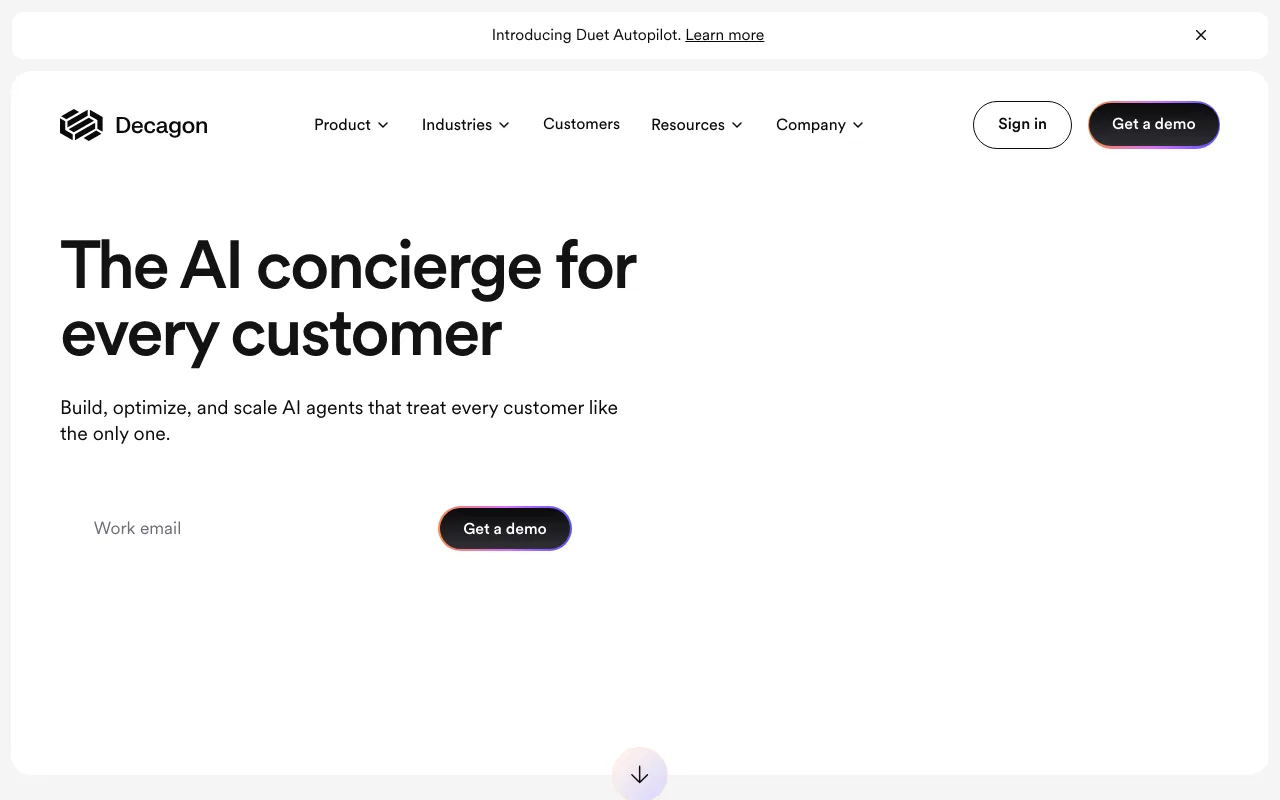
What is Decagon?
Decagon is an enterprise platform for building AI customer-service agents — what the company calls an “AI concierge” — that resolve support requests across chat, email, and voice from a single intelligence layer. Instead of programming conversation trees in a proprietary flow builder, teams write Agent Operating Procedures (AOPs) in plain natural language to describe how the agent should handle each scenario. The platform layers on Experiments for A/B testing agent behavior, Simulations for testing and QA at scale before deployment, and Watchtower for always-on quality monitoring of live conversations. AI-generated knowledge suggestions surface gaps in the underlying documentation as real conversations expose them.
Decagon sells to large organizations across airlines, banking, telecom, and retail, plus high-growth technology companies. Named customers include Chime, Duolingo, Notion, Rippling, Eventbrite, Substack, Oura, Affirm, and Bilt, and the company reports adding more than 100 new global enterprise customers during 2025. Reported outcomes are concrete: Chime states it reached 70% AI resolution across chat and voice while doubling NPS on AI-handled conversations. The company raised a $250 million Series D in January 2026 at a $4.5 billion valuation, led by Coatue Management and Index Ventures — roughly triple its earlier $1.5 billion Series C valuation.
Who is it for?
Decagon targets enterprises with high support volume that want to automate a large share of tickets without hard-coding brittle decision trees, and that can absorb a six-figure annual contract plus a white-glove implementation. There is no free tier, no self-serve trial, and no public pricing, so it is a poor fit for small teams or anyone who wants to evaluate before talking to sales. Pricing runs on either a per-conversation or a per-resolution model, both custom-quoted.
- Large consumer brands (fintech, retail, subscription apps) handling millions of support interactions a year across chat, email, and voice.
- Support and CX leaders who want to deflect routine tickets and redeploy human agents to complex, high-value cases.
- Regulated businesses (banking, fintech) that need identity verification and account actions handled inside compliant, auditable workflows.
- Ops teams that prefer defining agent behavior in natural language and iterating with A/B experiments and simulation-based QA rather than manual flow building.
How much does Decagon cost?
Starting price: Custom · Free tier: no · Model: contact
Price history tracked from June 2026
| Plan | Price | Includes |
|---|---|---|
| Custom (Enterprise) | Custom | No public pricing — quote requires a sales discovery call · Per-conversation or per-resolution billing models · Contracts typically start in six figures annually · Median annual contract ~$386K per third-party data (Vendr) · White-glove implementation and dedicated support · No free tier or self-serve trial |
What are Decagon's key features?
- Agent Operating Procedures (AOPs) — define agent workflows in plain natural language, no scripting language required
- Omnichannel deployment across chat, email, and voice from a single intelligence layer
- Experiments for A/B testing agent behavior against live traffic
- Simulations at scale for pre-deployment testing and QA
- Watchtower for always-on QA monitoring of live conversations
- Insights and reporting analytics on resolution and deflection
- AI-powered knowledge suggestions to close documentation gaps
- Tool connectors and API integrations into existing support and CRM systems
What people use Decagon for
- 01 Deflecting high-volume support tickets across chat, email, and voice so human agents focus on complex, high-value cases
- 02 Automating identity verification and account actions inside regulated support flows for fintech and banking
- 03 Running A/B experiments and always-on QA on AI agent responses before scaling changes to production
- 04 Standing up an omnichannel AI concierge for a consumer brand facing seasonal support spikes
- 05 Closing knowledge-base gaps using AI-suggested content drawn from real conversations
Pros and cons
| Pros | Cons |
|---|---|
| Handles enterprise-scale volume across chat, email, and voice from a single platform | No public pricing — every quote requires a sales discovery call, making budget comparison difficult before committing |
| Natural-language AOPs avoid the rigid, brittle configuration of traditional flow builders | Contracts typically start in six figures with a platform and implementation fee; there is no free tier or self-serve trial |
| Proven at large brands — customers include Chime, Duolingo, Notion, and Rippling; Chime reports 70% AI resolution | Per-resolution billing hinges on how a 'resolution' is defined, which can create billing disputes |
| Per-resolution billing option ties spend to outcomes rather than raw interaction count | Pricing figures here are third-party estimates (eesel, Vendr), not confirmed by Decagon, so treat them as directional |
| Well capitalized after a $250M Series D at a $4.5B valuation, reducing vendor-continuity risk |
What are the best Decagon alternatives?
CrewAI is the closest Decagon alternative in our directory: it covers the same category (AI Agents & Automation), starts at $0, has a free tier.
Ranked by category overlap with Decagon, then free-tier availability, then lowest verified starting price — computed from our verified data, never from sponsorships.
| Alternative | What it is | Starting price | Free tier | Price verified |
|---|---|---|---|---|
| CrewAI | Open-source multi-agent framework for orchestrating collaborative AI agent teams | $0 | yes | Jul 3, 2026 |
| Relevance AI | No-code platform for building and deploying autonomous AI agents for business workflows | $19/mo | yes | Jun 11, 2026 |
| Chatbase | No-code platform for building and deploying AI support agents trained on your own business data | $32/mo | yes | Jul 1, 2026 |
| Fin | Intercom's AI customer-service agent that resolves support tickets across chat, email, voice, and social — billed per resolution, not per seat | $0.99/outcome | no | Jul 8, 2026 |
| Lindy | No-code AI agents that handle email, calendar, meetings, and 100+ app integrations | $49.99/mo | no | Jun 21, 2026 |
| Sierra | Enterprise platform for branded customer-experience AI agents, billed on outcomes rather than seats or usage | Custom | no | Jul 14, 2026 |
Frequently asked questions
How much does Decagon cost?
Decagon does not publish public pricing. It uses custom quotes under two models — per-conversation or per-resolution — and contracts typically start in the six figures annually. Third-party data from Vendr puts the median annual contract around $386,000. Getting a number requires a sales discovery call.
Does Decagon have a free tier or trial?
No. There is no free tier or self-serve trial. Decagon is an enterprise platform sold through a sales process with white-glove implementation, so evaluation happens via a scoped pilot rather than a public sign-up.
What is the difference between per-conversation and per-resolution pricing?
Per-conversation charges a flat fee for every interaction the agent handles regardless of outcome, giving budget predictability. Per-resolution charges only for successfully closed tickets at a higher per-unit rate, aligning cost to results — but the price depends on how a 'resolution' is defined in the contract.
Who are Decagon's customers?
Decagon serves F100 enterprises and high-growth companies including Chime, Duolingo, Notion, Rippling, Eventbrite, Substack, Oura, Affirm, and Bilt. It added more than 100 new global enterprise customers during 2025.
What are Agent Operating Procedures?
Agent Operating Procedures (AOPs) let teams define agent workflows in plain natural language instead of a proprietary scripting or flow-builder language. They are Decagon's core method for configuring how agents handle different support scenarios.
Is Decagon well funded?
Yes. Decagon raised a $250 million Series D in January 2026 at a $4.5 billion valuation, led by Coatue Management and Index Ventures — roughly tripling its valuation from the earlier $1.5 billion Series C.
Does Decagon support voice and API access?
Yes. Decagon deploys across chat, email, and voice from a single intelligence layer, and offers API access plus tool connectors to integrate with existing support and CRM systems.